Tag Archives: artificial-intelligence

Phil 6.19.2025

Back from the bike trip! Wenatchee to Boise – 930 miles, 45k feet of climbing. Started a bit out of shape but found some form. I’m a lot slower than when I did this in 2012!

Tasks

  • Laundry – done
  • Bills
  • Groceries – done
  • Cleaning – done
  • Lawn – done
  • Unpack – everything but the bike

Your Brain on ChatGPT: Accumulation of Cognitive Debt when Using an AI Assistant for Essay Writing Task

  • This study explores the neural and behavioral consequences of LLM-assisted essay writing. Participants were divided into three groups: LLM, Search Engine, and Brain-only (no tools). Each completed three sessions under the same condition. In a fourth session, LLM users were reassigned to Brain-only group (LLM-to-Brain), and Brain-only users were reassigned to LLM condition (Brain-to-LLM). A total of 54 participants took part in Sessions 1-3, with 18 completing session 4. We used electroencephalography (EEG) to assess cognitive load during essay writing, and analyzed essays using NLP, as well as scoring essays with the help from human teachers and an AI judge. Across groups, NERs, n-gram patterns, and topic ontology showed within-group homogeneity. EEG revealed significant differences in brain connectivity: Brain-only participants exhibited the strongest, most distributed networks; Search Engine users showed moderate engagement; and LLM users displayed the weakest connectivity. Cognitive activity scaled down in relation to external tool use. In session 4, LLM-to-Brain participants showed reduced alpha and beta connectivity, indicating under-engagement. Brain-to-LLM users exhibited higher memory recall and activation of occipito-parietal and prefrontal areas, similar to Search Engine users. Self-reported ownership of essays was the lowest in the LLM group and the highest in the Brain-only group. LLM users also struggled to accurately quote their own work. While LLMs offer immediate convenience, our findings highlight potential cognitive costs. Over four months, LLM users consistently underperformed at neural, linguistic, and behavioral levels. These results raise concerns about the long-term educational implications of LLM reliance and underscore the need for deeper inquiry into AI’s role in learning.

And some counterpoint: Does using ChatGPT change your brain activity? Study sparks debate

Phil 5.28.2025

I really wonder if there is a political leaning to people who use ChatGPT to generate answers that they like. This came up on Quora:

I finally convinced the ChatGPT to give me the graph on a 0% to 100% scale so you see the real graph. Remember this is the Keeling Curve! It is exactly, the same data.

You might like to know it took me 5 times to get ChatGPT to actually, graph the data on this scale. The determination to lie in Climate Science is hard-coded into ChatGPT.

It might have to do with the concept of cognitive debt, which is related to Zipf’s Human Behavior and the Principle of Least Effort: An Introduction to Human Ecology, I think:

  • Where technical debt for an organisation is “the implied cost of additional work in the future resulting from choosing an expedient solution over a more robust one”, cognitive debt is where you forgo the thinking in order just to get the answers, but have no real idea of why the answers are what they are.

SBIRs

  • 9:00 – 12:00 Meeting with Aaron to get a good training/visualization running – Good progress!!!

Tasks

  • Set up proofreading – done
  • See if Emilia knows a lawyer – done
  • 4:00 Meeting with Nellie – looks like August? Need to do steps, floor, and some painting

Phil 4.10.2025

Tasks

  • Groceries!

SBIRs

  • Need to ping T about expensis
  • 9:00 Standup
  • 1:00 RTAT

GPT Agents

  • A Survey of Social Cybersecurity: Techniques for Attack Detection, Evaluations, Challenges, and Future Prospects
    • In today’s digital era, the Internet, especially social media platforms, plays a significant role in shaping public opinions, attitudes, and beliefs. Unfortunately, the credibility of scientific information sources is often undermined by the spread of misinformation through various means, including technology-driven tools like bots, cyborgs, trolls, sock-puppets, and deep fakes. This manipulation of public discourse serves antagonistic business agendas and compromises civil society. In response to this challenge, a new scientific discipline has emerged: social cybersecurity.
  • Do Large Language Models Solve the Problems of Agent-Based Modeling? A Critical Review of Generative Social Simulations
    • Recent advancements in AI have reinvigorated Agent-Based Models (ABMs), as the integration of Large Language Models (LLMs) has led to the emergence of “generative ABMs” as a novel approach to simulating social systems. While ABMs offer means to bridge micro-level interactions with macro-level patterns, they have long faced criticisms from social scientists, pointing to e.g., lack of realism, computational complexity, and challenges of calibrating and validating against empirical data. This paper reviews the generative ABM literature to assess how this new approach adequately addresses these long-standing criticisms. Our findings show that studies show limited awareness of historical debates. Validation remains poorly addressed, with many studies relying solely on subjective assessments of model `believability’, and even the most rigorous validation failing to adequately evidence operational validity. We argue that there are reasons to believe that LLMs will exacerbate rather than resolve the long-standing challenges of ABMs. The black-box nature of LLMs moreover limit their usefulness for disentangling complex emergent causal mechanisms. While generative ABMs are still in a stage of early experimentation, these findings question of whether and how the field can transition to the type of rigorous modeling needed to contribute to social scientific theory.

Phil 3.17.2025

Pour one out – er, I mean in – for Saint Patrick

And I have said for a long time that we will know this administration by the way it treats the members of the Jan 6 committee, and Liz Cheney in particular:

I got cited! Feeds of Distrust: Investigating How AI-Powered News Chatbots Shape User Trust and Perceptions

  • The start of the 2020s ushered in a new era of Artificial Intelligence through the rise of Generative AI Large Language Models (LLMs) such as Chat-GPT. These AI chatbots offer a form of interactive agency by enabling users to ask questions and query for more information. However, prior research only considers if LLMs have a political bias or agenda, and not how a biased LLM can impact a user’s opinion and trust. Our study bridges this gap by investigating a scenario where users read online news articles and then engage with an interactive AI chatbot, where both the news and the AI are biased to hold a particular stance on a news topic. Interestingly, participants were far more likely to adopt the narrative of a biased chatbot over news articles with an opposing stance. Participants were also substantially more inclined to adopt the chatbot’s narrative if its stance aligned with the news—all compared to a control news-article only group. Our findings suggest that the very interactive agency offered by an AI chatbot significantly enhances its perceived trust and persuasive ability compared to the ‘static’ articles from established news outlets, raising concerns about the potential for AI-driven indoctrination. We outline the reasons behind this phenomenon and conclude with the implications of biased LLMs for HCI research, as well as the risks of Generative AI undermining democratic integrity through AI-driven Information Warfare.

Asymmetric power in the information age

  • The ubiquity of digital & social media has disrupted how democratic societies function. Journalists, politicians, and citizens often frame the problems of social media in the context of misinformation, about how lies spread faster than the truth, and how people seek information that comforts their beliefs. My personal interests were always more concerned about how the interactions of humans with algorithmic online systems at scale create emergent meta-phenomena.

Tasks

  • IGNITE slides
  • Return KP call
  • 3:00 Vision exam

Phil 2.12.2025

Snowed about 5-6 inches last night, so I need to dig out before the “wintry mix” hits around noon

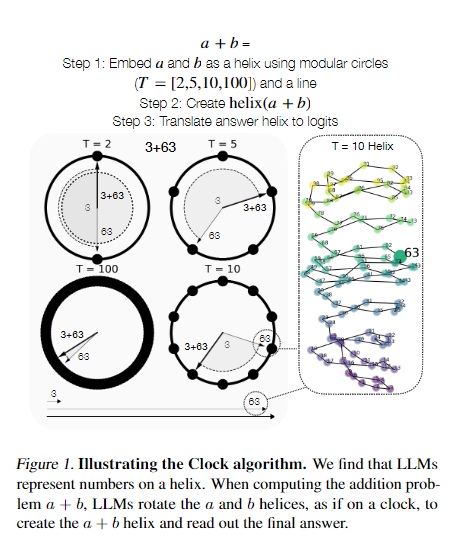
Language Models Use Trigonometry to Do Addition

  • Mathematical reasoning is an increasingly important indicator of large language model (LLM) capabilities, yet we lack understanding of how LLMs process even simple mathematical tasks. To address this, we reverse engineer how three mid-sized LLMs compute addition. We first discover that numbers are represented in these LLMs as a generalized helix, which is strongly causally implicated for the tasks of addition and subtraction, and is also causally relevant for integer division, multiplication, and modular arithmetic. We then propose that LLMs compute addition by manipulating this generalized helix using the “Clock” algorithm: to solve a+b, the helices for a and b are manipulated to produce the a+b answer helix which is then read out to model logits. We model influential MLP outputs, attention head outputs, and even individual neuron preactivations with these helices and verify our understanding with causal interventions. By demonstrating that LLMs represent numbers on a helix and manipulate this helix to perform addition, we present the first representation-level explanation of an LLM’s mathematical capability.

GPT Agents

  • Slide deck – Add this: Done

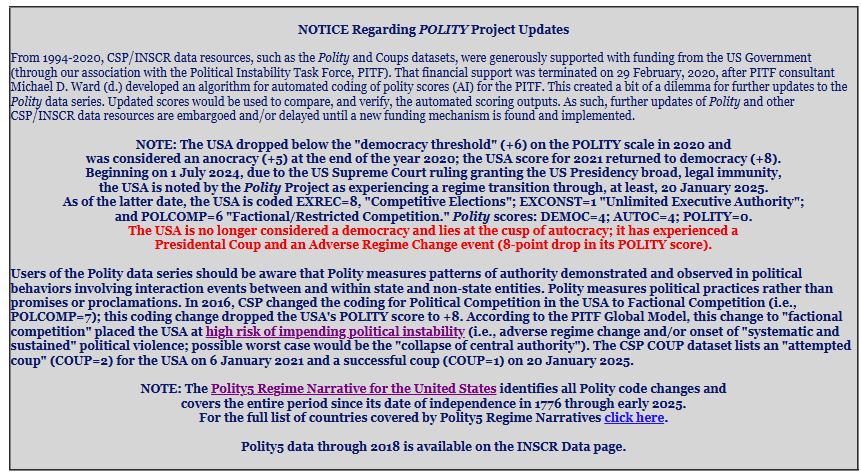
NOTE: The USA dropped below the “democracy threshold” (+6) on the POLITY scale in 2020 and was considered an anocracy (+5) at the end of the year 2020; the USA score for 2021 returned to democracy (+8). Beginning on 1 July 2024, due to the US Supreme Court ruling granting the US Presidency broad, legal immunity, the USA is noted by the Polity Project as experiencing a regime transition through, at least, 20 January 2025. As of the latter date, the USA is coded EXREC=8, “Competitive Elections”; EXCONST=1 “Unlimited Executive Authority”; and POLCOMP=6 “Factional/Restricted Competition.” Polity scores: DEMOC=4; AUTOC=4; POLITY=0.

The USA is no longer considered a democracy and lies at the cusp of autocracy; it has experienced a Presidential Coup and an Adverse Regime Change event (8-point drop in its POLITY score).

  • Work more on conclusions? Yes!
  • TiiS? Nope

SBIRs

  • 9:00 IRAD Monthly – done
  • Actually got some good work on automating file generation using config files.

Phil 2.6.2025

From The Bulwark. Good example of creating a social reality and using it for an organizational lobotomy. Add to the book following Jan 6 section?

Full thread here

There is an interesting blog post (and thread) from Tim Kellogg that says this:

  • Context: When an LLM “thinks” at inference time, it puts it’s thoughts inside <think> and </think> XML tags. Once it gets past the end tag the model is taught to change voice into a confident and authoritative tone for the final answer.
  • In s1, when the LLM tries to stop thinking with “”, they force it to keep going by replacing it with “Wait”. It’ll then begin to second guess and double check it’s answer. They do this to trim or extend thinking time (trimming is just abruptly inserting “/think>”).

This is the paper: s1: Simple test-time scaling

  • Test-time scaling is a promising new approach to language modeling that uses extra test-time compute to improve performance. Recently, OpenAI’s o1 model showed this capability but did not publicly share its methodology, leading to many replication efforts. We seek the simplest approach to achieve test-time scaling and strong reasoning performance. First, we curate a small dataset s1K of 1,000 questions paired with reasoning traces relying on three criteria we validate through ablations: difficulty, diversity, and quality. Second, we develop budget forcing to control test-time compute by forcefully terminating the model’s thinking process or lengthening it by appending “Wait” multiple times to the model’s generation when it tries to end. This can lead the model to double-check its answer, often fixing incorrect reasoning steps. After supervised finetuning the Qwen2.5-32B-Instruct language model on s1K and equipping it with budget forcing, our model s1-32B exceeds o1-preview on competition math questions by up to 27% (MATH and AIME24). Further, scaling s1-32B with budget forcing allows extrapolating beyond its performance without test-time intervention: from 50% to 57% on AIME24. Our model, data, and code are open-source at this https URL

Tasks

SBIRs

  • 9:00 standup – done
  • 10:00 MLOPS whitepaper review
  • 12:50 USNA

Phil 1.30.2025

Copyright Office Releases Part 2 of Artificial Intelligence Report

  • Today, the U.S. Copyright Office is releasing Part 2 of its Report on the legal and policy issues related to copyright and artificial intelligence (AI). This Part of the Report addresses the copyrightability of outputs created using generative AI. The Office affirms that existing principles of copyright law are flexible enough to apply to this new technology, as they have applied to technological innovations in the past. It concludes that the outputs of generative AI can be protected by copyright only where a human author has determined sufficient expressive elements. This can include situations where a human-authored work is perceptible in an AI output, or a human makes creative arrangements or modifications of the output, but not the mere provision of prompts. The Office confirms that the use of AI to assist in the process of creation or the inclusion of AI-generated material in a larger human-generated work does not bar copyrightability. It also finds that the case has not been made for changes to existing law to provide additional protection for AI-generated outputs.

AI research team claims to reproduce DeepSeek core technologies for $30 — relatively small R1-Zero model has remarkable problem-solving abilities | Tom’s Hardware

  • An AI research team from the University of California, Berkeley, led by Ph.D. candidate Jiayi Pan, claims to have reproduced DeepSeek R1-Zero’s core technologies for just $30, showing how advanced models could be implemented affordably. According to Jiayi Pan on Nitter, their team reproduced DeepSeek R1-Zero in the Countdown game, and the small language model, with its 3 billion parameters, developed self-verification and search abilities through reinforcement learning.

Made a gif of a root growing as a metaphor for an LLM generating text from the same prompt four times (from this video):

P33

  • Added no confidence voting

GPT Agents

  • Arms control – finished!

SBIRs

  • 9:00 standup
  • 12:50 – 1:20 USNA
  • 4:30 book club
  • More RTAT – Worked out how to iterate along the line segments as a function of t.

Phil 9.30.2024

Larger and more instructable language models become less reliable

  • The prevailing methods to make large language models more powerful and amenable have been based on continuous scaling up (that is, increasing their size, data volume and computational resources1) and bespoke shaping up (including post-filtering2,3, fine tuning or use of human feedback4,5). However, larger and more instructable large language models may have become less reliable. By studying the relationship between difficulty concordance, task avoidance and prompting stability of several language model families, here we show that easy instances for human participants are also easy for the models, but scaled-up, shaped-up models do not secure areas of low difficulty in which either the model does not err or human supervision can spot the errors. We also find that early models often avoid user questions but scaled-up, shaped-up models tend to give an apparently sensible yet wrong answer much more often, including errors on difficult questions that human supervisors frequently overlook. Moreover, we observe that stability to different natural phrasings of the same question is improved by scaling-up and shaping-up interventions, but pockets of variability persist across difficulty levels. These findings highlight the need for a fundamental shift in the design and development of general-purpose artificial intelligence, particularly in high-stakes areas for which a predictable distribution of errors is paramount.

SBIRs

  • 10:30 LM followup. Moved the WP to LaTeX. Not sure about next steps
  • 2:30 MDA meeting

Grants

  • Finish proposal 10 – done! I think I’ll submit this one and see how it fits in the EasyChair format before doing the next one.

GPT Agents

  • Work on challenges section

Phil 9.27.2024

That is a lot of rain:

Learned feature representations are biased by complexity, learning order, position, and more

  • Representation learning, and interpreting learned representations, are key areas of focus in machine learning and neuroscience. Both fields generally use representations as a means to understand or improve a system’s computations. In this work, however, we explore surprising dissociations between representation and computation that may pose challenges for such efforts. We create datasets in which we attempt to match the computational role that different features play, while manipulating other properties of the features or the data. We train various deep learning architectures to compute these multiple abstract features about their inputs. We find that their learned feature representations are systematically biased towards representing some features more strongly than others, depending upon extraneous properties such as feature complexity, the order in which features are learned, and the distribution of features over the inputs. For example, features that are simpler to compute or learned first tend to be represented more strongly and densely than features that are more complex or learned later, even if all features are learned equally well. We also explore how these biases are affected by architectures, optimizers, and training regimes (e.g., in transformers, features decoded earlier in the output sequence also tend to be represented more strongly). Our results help to characterize the inductive biases of gradient-based representation learning. We then illustrate the downstream effects of these biases on various commonly-used methods for analyzing or intervening on representations. These results highlight a key challenge for interpretability—or for comparing the representations of models and brains—disentangling extraneous biases from the computationally important aspects of a system’s internal representations.

More AI slop:

Amazing to watch Google destroy its core functionality chasing AI. Friends on the groupchat were talking about Rickey Henderson, who threw left and hit from the right side, which is really rare. If you go to google to find other throw left/bat right players. This is what its AI gives you.

Chris Hayes (@chrislhayes.bsky.social) 2024-09-27T18:49:17.788Z

From https://bsky.app/profile/chrislhayes.bsky.social/post/3l55tbzk5ue2e. He continues: “This is is garbage! It’s worst than useless, it’s misleading! If you looked at it quickly you’d think Babe Ruth and Shohei also both threw left and batted right. Sure this is trivial stuff but the whole point is finding accurate information.

Chores today

  • Clean House – done!
  • Recycle – Done
  • Bills (TRP!) – Done
  • Prep for Seagull! – Done enough.

Grants

  • Finish proposal 14 – Good proposal! Now I need to write the reviews

9.26.2024

Really good example of potential sources of AI pollution as it applies to research. Vetting sources may become progressively harder as the AI is able to interpolate across more data. More detail is in the screenshot:

The alt text describes “Screenshot of a Bridgeman Images page, which shows what appears to be a 19th-century photograph of a man in a top hat, but which has appended metadata for a completely different work of art, namely, a late medieval manuscript, which features an image of the author Pierre Bersuire presenting his book to the King of France.

[2401.03315] Malla: Demystifying Real-world Large Language Model Integrated Malicious Services (arxiv.org)

  • The underground exploitation of large language models (LLMs) for malicious services (i.e., Malla) is witnessing an uptick, amplifying the cyber threat landscape and posing questions about the trustworthiness of LLM technologies. However, there has been little effort to understand this new cybercrime, in terms of its magnitude, impact, and techniques. In this paper, we conduct the first systematic study on 212 real-world Mallas, uncovering their proliferation in underground marketplaces and exposing their operational modalities. Our study discloses the Malla ecosystem, revealing its significant growth and impact on today’s public LLM services. Through examining 212 Mallas, we uncovered eight backend LLMs used by Mallas, along with 182 prompts that circumvent the protective measures of public LLM APIs. We further demystify the tactics employed by Mallas, including the abuse of uncensored LLMs and the exploitation of public LLM APIs through jailbreak prompts. Our findings enable a better understanding of the real-world exploitation of LLMs by cybercriminals, offering insights into strategies to counteract this cybercrime.
  • Citations: Lin: Malla: Demystifying Real-world Large Language… – Google Scholar

[2310.05595] Decoding the Threat Landscape : ChatGPT, FraudGPT, and WormGPT in Social Engineering Attacks (arxiv.org)

  • In the ever-evolving realm of cybersecurity, the rise of generative AI models like ChatGPT, FraudGPT, and WormGPT has introduced both innovative solutions and unprecedented challenges. This research delves into the multifaceted applications of generative AI in social engineering attacks, offering insights into the evolving threat landscape using the blog mining technique. Generative AI models have revolutionized the field of cyberattacks, empowering malicious actors to craft convincing and personalized phishing lures, manipulate public opinion through deepfakes, and exploit human cognitive biases. These models, ChatGPT, FraudGPT, and WormGPT, have augmented existing threats and ushered in new dimensions of risk. From phishing campaigns that mimic trusted organizations to deepfake technology impersonating authoritative figures, we explore how generative AI amplifies the arsenal of cybercriminals. Furthermore, we shed light on the vulnerabilities that AI-driven social engineering exploits, including psychological manipulation, targeted phishing, and the crisis of authenticity. To counter these threats, we outline a range of strategies, including traditional security measures, AI-powered security solutions, and collaborative approaches in cybersecurity. We emphasize the importance of staying vigilant, fostering awareness, and strengthening regulations in the battle against AI-enhanced social engineering attacks. In an environment characterized by the rapid evolution of AI models and a lack of training data, defending against generative AI threats requires constant adaptation and the collective efforts of individuals, organizations, and governments. This research seeks to provide a comprehensive understanding of the dynamic interplay between generative AI and social engineering attacks, equipping stakeholders with the knowledge to navigate this intricate cybersecurity landscape.
  • Citations: Falade: Decoding the threat landscape: Chatgpt, fraudgpt,… – Google Scholar

SBIRs

  • Meeting in NJ today, so mostly travel
  • Realized that I may be able to generate a lot of trajectories really quick by having a base trajectory and an appropriate envelope to contain whatever function (sin wave, random walk, etc) I want to overlay. Train that first, and then have a second model that uses the first to calculate the likely interception point. Kind of what like google does (did?) with predictive search modelling
  • Book club

Phil 4.15.2024

Tax day!

Read Collective intelligence: A unifying concept for integrating biology across scales and substrates, which is wild, and feeds into the prompt-as-life concept I’ve been toying with. Among other things, it opens up experiments to show the level of self-organization available to prompts:

  • A central claim of the emerging field of diverse intelligence is that cognitive capacities (Box. 1) exist on a spectrum: that tools, concepts, and approaches from behavioral sciences can be productively applied to understand and control systems far beyond familiar animals with central nervous systems (without the necessity to attribute advanced, human-level metacognitive traits). 
  • Biological intelligent systems demonstrate increased ability to achieve their (collective) goals despite obstacles by integrating the individual competencies of their components (which can perform tasks in their own space without any inkling of the large-scale goals to which they contribute)
  • Thus, the physiological process that leads to the emergence of integrated collectives, which scientists and conspecifics recognize as discrete individuals is fundamentally dependent on the geometry of interactions (and signaling barriers) present during the early establishment of individuality and the setting of borders between Self and outside world (since every cell is some other cell’s adjacent neighbor).
  • However, the more interesting and fundamental issue is seen when considering just one cut: the cells on either side of the cut will create a head and tail respectively, but they were adjacent neighbors before the cut and located at the same positional information value. In other words, it is actually impossible for an anatomical decision like this to be made locally – the cells of the wound must coordinate with the remaining fragment to get information about where they are located, which way they are facing, and what other structures exist121,122, in order to make adaptive decisions about large-scale growth and form that enable regeneration of normal worms.
  • This recruitment of individuals to accomplish a high-level goal is seen in other collective systems like ant colonies152,153, which often call in helpers when a task is large. The ability to recruit participants to complete tasks may be a central competency of collective intelligence that works across scales, from cells to swarms of entire organisms7.
  • Cell and developmental biology offer very rich fodder for the emerging field of diverse intelligence: discovering a vast spectrum of problem-solving capacities in novel substrates and at unconventional spatiotemporal scales. Because of life’s multi-scale competency architecture, a fundamental aspect of intelligence is collective behavior: all intelligences appear to be made of parts, connected by mechanisms implementing policies that bind the competent components into a cooperative (and competitive6) computational medium that solves problems in new spaces and at higher scales.
  • Importantly, the definition of intelligence as the ability to reach the same endpoint despite internal or external changes emphasizes not only robustness (successful use of novel navigational policies to overcome perturbations) but also its failure modes. Numerous ways of targeting of its sensory, memory, decision-making, or other components can de-rail the performance of a collective intelligence, resulting in birth defects and malformations.
    • I think this is a really important way to probe and examine prompts and models. How well do they reach their goals when damaged, and how do they do it.
  • Cancer, a kind of dissociative identity disorder of the somatic collective intelligence109, limitations in regenerative ability, and many physiological disorders could all be advanced by techniques that exploit not just the low-level mechanisms, but also the higher-level decision-making of life16,17
  • Living matter is a kind of agential material with the ability to propagate information across scales – a phenomenon which has many implications for evolution9, and for bioengineering21.

Ordered The Sentient Cell: The Cellular Foundations of Consciousness

SBIRS

  • Write email summary of Friday’s meeting. Also find out who I send the MCMC description to. Done
  • Start slide deck for the 22nd – started! Using ContextExplorer which is really good for this sort of thing.
  • Submit paper – done
  • Gotta rewrite the final report in a way that “substantially revises” it. Sigh. Waiting for some direction from someone in authority.