Phil 8.12.2023

Algorithms and agenda-setting in Wikileaks’ #Podestaemails release

  • In the month before the 2016 U.S. Presidential election, Wikileaks released 37 serialized batches of e-mails authored by former Clinton campaign manager John Podesta. Each release was announced using a unique PodestaEmail related hashtag (#PodestaEmails2, #PodestaEmails3, etc.). In total, Podesta e-mail related hashtags hit town-wide, country-wide, or worldwide Trending topics lists a total of 1,917 times, remaining on Trending Topic lists everyday within the U.S. for 30 days before election day. In this article, we discuss how Wikileaks’ release methodology increased the potential reach of Podesta E-mail related content. We describe how Wikileaks’ tweets spoke to two audiences: Twitter users and Twitter algorithms. In serializing its content and using new hashtags for each release, Wikileaks increased the potential persistence, visibility, spreadability, and searchability of this content. By creating the possibility for this content to remain persistently visible on the Trending Topics list, Wikileaks was able to potentially realize a greater degree of agenda-setting than would have been possible through singular hashtag use.

Doxfare: Politically Motivated Leaks and the Future of the Norm on Non-Intervention in the Era of Weaponized Information.

  • Alleged Russian digital interference during the 2016 U.S. presidential election presented international law with the challenge of characterizing the phenomenon of politically motivated leaks by foreign actors, carried out in cyberspace. Traditionally, international law’s norm of non-intervention applies only to acts that are coercive in nature, leaving disruptive acts outside the scope of prohibited intervention. This notion raises a host of questions on the relevancy and limited flexibility of traditional international law in relation to new threats and challenges emanating from the use of cyberspace capabilities. The discourse on transnational cyberspace operations highlights how it has become increasingly difficult to deal with nuanced activities that may cause unprecedented harms, such as the hack of the Democratic National Committee, as well as disinformation campaigns on social media, online propaganda, and sensitive information leaks. This Article argues that state interference with a legitimate political process in another state through cyberspace ought to be considered a violation of the norm of non-intervention. Although the constitutive coercion element is seemingly absent, international law should adapt to the digital era’s threats and consider non-coercive interferences that constitute “doxfare”–the public release of sensitive documents with the intent of disrupting legitimate domestic processes–as violations of the norm. As this paper contends, cyberspace operations are distinct in their effects from their physical counterparts, so a traditional standard of coercion for the norm on non-intervention is outdated and requires the introduction of a more nuanced approach, that takes into account interventions that are non-coercive in nature.

Effects of Algorithmic Trend Promotion: Evidence from Coordinated Campaigns in Twitter’s Trending Topics

  • In addition to more personalized content feeds, some leading social media platforms give a prominent role to content that is more widely popular. On Twitter, “trending topics” identify popular topics of conversation on the platform, thereby promoting popular content which users might not have otherwise seen through their network. Hence, “trending topics” potentially play important roles in influencing the topics users engage with on a particular day. Using two carefully constructed data sets from India and Turkey, we study the effects of a hashtag appearing on the trending topics page on the number of tweets produced with that hashtag. We specifically aim to answer the question: How many new tweeting using that hashtag appear because a hashtag is labeled as trending? We distinguish the effects of the trending topics page from network exposure and find there is a statistically significant, but modest, return to a hashtag being featured on trending topics. Analysis of the types of users impacted by trending topics shows that the feature helps less popular and new users to discover and spread content outside their network, which they otherwise might not have been able to do.

Phil 8.11.2023

CORE-GPT: Combining Open Access research and AI for credible, trustworthy question answering

  • Looks like more context prompting with their own (maybe Llama?) LLM?
  • Has been accepted to TPDL2023

SBIR’s

  • Soooo many meetings today. I may do my ride at 8:30 – done!
  • 10:30 Dahlgren
  • 11:00 Intern presentation – much better than the dry run
  • 12:00 Technical fellows – as dull as possible
  • 1:00 Meeting with Aaron on white paper. We added some LOE information for Monday’s meeting
  • Finish sprint, including abstract and slides – never got a chance. Need to do that before Monday morning though

GPT Agents

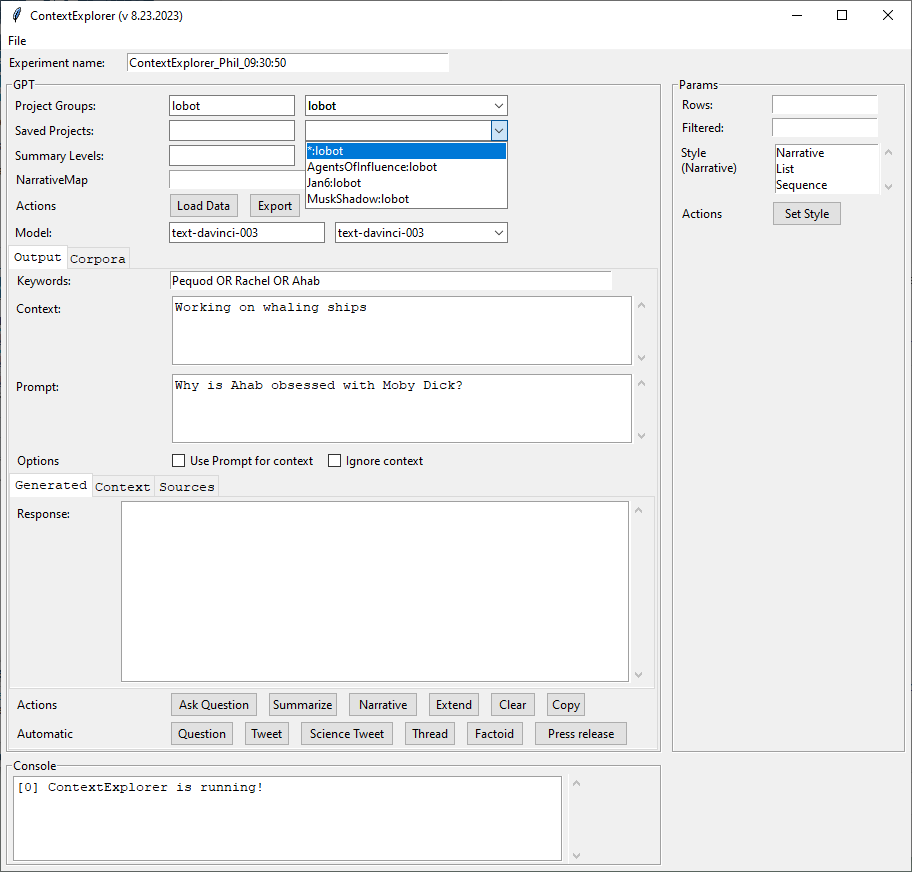
  • More dev with Zach. Lot’s done. Need to add a “role” to the subject table that has “researcher,” “faculty,” “professor,” etc. Maybe as dropdown?

Phil 8.10.2023

SBIRs

  • Day trip to NJ for interns. It’s going to be a looooong day
  • Tweaked the code example a bit to include the Obfuscated C Code Competition, since that always seems to come up
  • More editing of scenario three

GPT Agents

  • Lot of progress yesterday. I showed Jimmy the current state of things and he suggested making the error counting show just one item at a time. That should work nicely because the low-token prompt could go out first, and we could wait for the context prompt to finish while working on the first prompt.

Phil 8.9.2023

Got an invite to be on the IUI 2024 program committee. I think I have to accept.

Order batteries!

From Pretraining Data to Language Models to Downstream Tasks: Tracking the Trails of Political Biases Leading to Unfair NLP Models

  • Language models (LMs) are pretrained on diverse data sources, including news, discussion forums, books, and online encyclopedias. A significant portion of this data includes opinions and perspectives which, on one hand, celebrate democracy and diversity of ideas, and on the other hand are inherently socially biased. Our work develops new methods to (1) measure political biases in LMs trained on such corpora, along social and economic axes, and (2) measure the fairness of downstream NLP models trained on top of politically biased LMs. We focus on hate speech and misinformation detection, aiming to empirically quantify the effects of political (social, economic) biases in pretraining data on the fairness of high-stakes social-oriented tasks. Our findings reveal that pretrained LMs do have political leanings that reinforce the polarization present in pretraining corpora, propagating social biases into hate speech predictions and misinformation detectors. We discuss the implications of our findings for NLP research and propose future directions to mitigate unfairness.

SBIRs

  • 2:00 BMD status
  • Sent a bunch of papers over to the interns for the background section
  • Started on the Q6 report

GPT Agents

  • 8:30 – 9:30 more app development. And have the email domains rippled out yet?
    • Great progress!
  • 3:00 – 4:00 more app development. Need to get the public version running before the meeting.
  • 2:30 Alden meeting?
  • 4:00 LLM meeting

Phil 8.8.2023

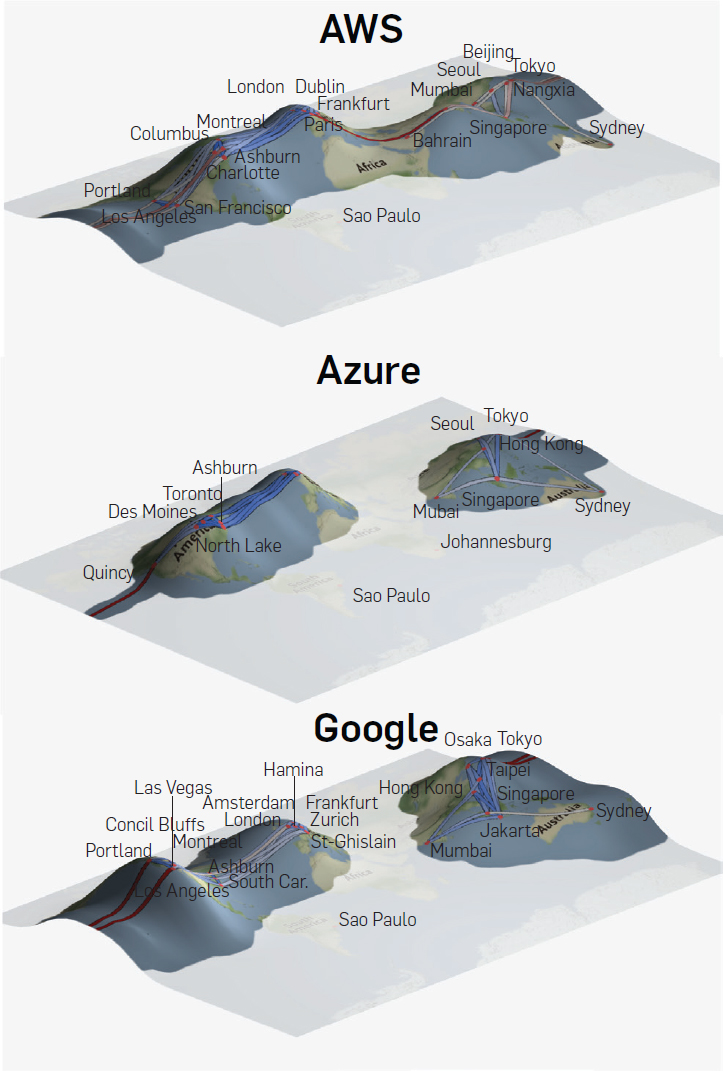
Love this:

Looks like ASRC Federal is going to create a technical fellows program. Need to schedule some time to fill out the application

SBIRs

  • 9:00 Standup
  • 3:00(?) MDA meeting

GPT Agents

  • More dev. Next is to isolate the UUID and get the LangChain calls working. Nope, worked on getting the UUID checked and placing all the experiment data in a class. Not sexy, but very cool. More work tomorrow

Phil 8.7.2023

SBIRs

  • Lots of meetings today. Like, 5 of them
  • Working on the paper on the gaps – good progress!
  • Some back and forth with Bob S. on generating data

GPT Agents.

  • More work on the app. Got the email sending properly, which turned out to be MUCH more complicated that we thought. You need to have a domain that the email can be sent from. Anyway, got that set up but waiting a day for the domain to ripple
  • Got the context root working so the app is live, if not actually working. You can see the current state here
  • Next is to isolate the UUID and get the Langchain calls working

Phil 8.4.2023

It looks like COVID might be coming back this fall. Wastewater levels are rising in Europe and the US. Mostly Delaware at the moment

SBIRs

  • Creating appendices
  • Starting on email section
  • Somehow lost the simple_sabotage entry in the database – re-sourcing. Done. Also committed the db. I think the repo was having problems the last time I tried this so that may be the source of my woes.
  • Need to list all the * entries first?

Phil 8.3.2023

Large Language Models as Corporate Lobbyists

  • We demonstrate a proof-of-concept of a large language model conducting corporate lobbying related activities. An autoregressive large language model (OpenAI’s text-davinci-003) determines if proposed U.S. Congressional bills are relevant to specific public companies and provides explanations and confidence levels. For the bills the model deems as relevant, the model drafts a letter to the sponsor of the bill in an attempt to persuade the congressperson to make changes to the proposed legislation. We use hundreds of novel ground-truth labels of the relevance of a bill to a company to benchmark the performance of the model. It outperforms the baseline of predicting the most common outcome of irrelevance. We also benchmark the performance of the previous OpenAI GPT-3 model (text-davinci-002), which was the state-of-the-art model on many academic natural language tasks until text-davinci-003 was recently released. The performance of text-davinci-002 is worse than the simple baseline. Longer-term, if AI begins to influence law in a manner that is not a direct extension of human intentions, this threatens the critical role that law as information could play in aligning AI with humans. Initially, AI is being used to simply augment human lobbyists for a small portion of their daily tasks. However, firms have an incentive to use less and less human oversight over automated assessments of policy ideas and the written communication to regulatory agencies and Congressional staffers. The core question raised is where to draw the line between human-driven and AI-driven policy influence.

Can Large Language Models Change User Preference Adversarially?

  • Pretrained large language models (LLMs) are becoming increasingly powerful and ubiquitous in mainstream applications such as being a personal assistant, a dialogue model, etc. As these models become proficient in deducing user preferences and offering tailored assistance, there is an increasing concern about the ability of these models to influence, modify and in the extreme case manipulate user preference adversarially. The issue of lack of interpretability in these models in adversarial settings remains largely unsolved. This work tries to study adversarial behavior in user preferences from the lens of attention probing, red teaming and white-box analysis. Specifically, it provides a bird’s eye view of existing literature, offers red teaming samples for dialogue models like ChatGPT and GODEL and probes the attention mechanism in the latter for non-adversarial and adversarial settings.

SBIRs

  • 9:00 Standup
  • More paper. Start on the Vignette 2 analysis. Move the extensive examples to the appendix
  • Create some concept art for the SGPT screens – done!

SBIRs

  • Work with Zach to connect the back end? Goof progress. Stored data to the db and managed to send an email!

Phil 8.2.2023

Funeral for Mike yesterday. Sigh

Research.com seems kinda useful, actually. It looks like a good place to find good upcoming conferences and venues

Anatomy of an AI-powered malicious social botnet

  • Large language models (LLMs) exhibit impressive capabilities in generating realistic text across diverse subjects. Concerns have been raised that they could be utilized to produce fake content with a deceptive intention, although evidence thus far remains anecdotal. This paper presents a case study about a Twitter botnet that appears to employ ChatGPT to generate human-like content. Through heuristics, we identify 1,140 accounts and validate them via manual annotation. These accounts form a dense cluster of fake personas that exhibit similar behaviors, including posting machine-generated content and stolen images, and engage with each other through replies and retweets. ChatGPT-generated content promotes suspicious websites and spreads harmful comments. While the accounts in the AI botnet can be detected through their coordination patterns, current state-of-the-art LLM content classifiers fail to discriminate between them and human accounts in the wild. These findings highlight the threats posed by AI-enabled social bots.

SBIRs

  • Talk to Zach about SGPT BD case?
  • Work on the paper. Finished a second pass on the “Gumming up the Works” Vignette. Fixed a bunch of mad writing and generally cleaned things up.
  • Fill out forms! Done! Aaron’s too!

GPT Agents

  • See if I can get some DB and OpenAI calls set up
  • IRB
  • 4:00 Meeting

Phil 8.1.2023

SBIRs

  • Went into the office yesterday, which was fun
  • Got my new laptop with card reader. Nice little box! I was just expecting to re-image my old one
  • Got more account stuff set up. Forgot about GitLab
  • Weekly MDA meeting. Pete finished his first pass at the white paper, which needs to be fleshed out. We agreed that SEG would make changes this week and then we would take over next week when Aaron gets back
  • Made a presentation to the interns and talked about goals, human nature, LLMs, and technology
  • 9:00 Sprint planning
  • Expenses!
  • More paper!
  • Leaving early for Mike’s funeral

GPT Agents

  • Pinged Zach about getting back on the App
  • Start IRM submission

Phil 7.27.2023

This quote comes from a Washington Post article on how the Ukraine war is affecting development of AI-powered drones. I think it generalizes more broadly to how disadvantaged groups are driven to embrace alternatives that are outside conventional norms.

Ukraine doesn’t have the ability to fight the much larger Russia. Russia may have issues with corruption and the quality of its weapons, but it has a lot of them. And from the perspective of Ukraine, Russia has an infinite number of soldiers. So many that they can be squandered.

The West is providing Ukraine with enough weapons to survive, but not enough to attack and win decisively. I’ve read analysis where experts say that weapons systems are arriving just about as fast as Ukraine can incorporate them, but the order of delivery is from less-capable to more capable. They have artillery, but no F-16s, for example.

As a result, Ukraine is having to improvise and adapt. Since it is facing an existential risk, it’s not going to be too picky about the ethics of smart weapons. If AI helps in targeting, great. If Russia is jamming the control signals to drones, then AI can take over. There is a coevolution between the two forces, and the result may very well be cheap, effective AI combat drones that are largely autonomous in the right conditions.

Such technology is cheap and adaptable. Others will use it, and it will slowly trickle down to the level that a lone wolf in a small town can order the parts that can inflict carnage on the local school. Or something else. The problem is that the diffusion of technology and its associated risks are difficult to predict and manage. But the line that leads to this kind of tragedy will have its roots in our decision to starve Ukraine of the weapons that it needed to win quickly.

Of course, Ukraine isn’t the only smaller country facing an existential risk. Many low-lying countries, particularly those nearer the equator are facing similar risks from climate change – both from killing heat and sea level rise. Technology – as unproven as combat AI – exists for that too. It’s called Geoengineering.

We’ve been doing geoengineering for decades of course. By dumping megatons of carbon dioxide and other compounds in the atmosphere, we are heating our planet and are now arriving at a tipping point where potential risks are going to become very real and immediate for certain countries. If I were facing the destruction of my country by flooding and heat, I’d be looking at geoengineering very seriously. Particularly since the major economies are not doing much to stop it.

Which means that I expect that we will see efforts like the injection of sulfate aerosols into the upper atmosphere, or cloud brightening, or the spreading of iron or other nutrients to the oceans to increase the amount of phytoplankton to consume CO2. Or something else even more radical. Like Ukraine, these countries have limited budgets and limited options. They will be creative, and not worry too much about the side effects.

It’s a 24/7 technology race without a finish line. The racers are just trying to outrun disaster. And no one knows where that may lead.

SBIRs

  • 9:00 Standup
  • Finish slide deck
  • Server stuff
  • More paper

GPT Agents

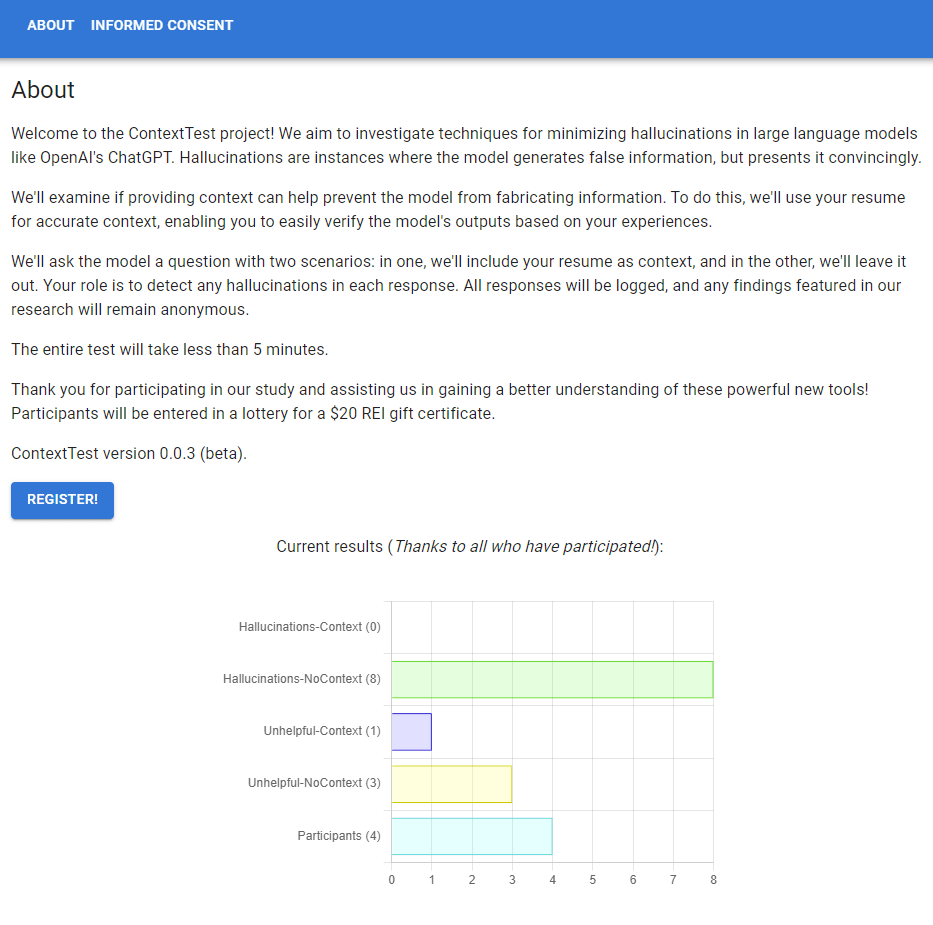
  • Add a “withdraw” page and move the about page to home, then informed consent
  • Work on IRB
  • Ping Zach

Phil 7.26.2023

Visuospatial information foraging describes search behavior in learning latent environmental features

  • In the real world, making sequences of decisions to achieve goals often depends upon the ability to learn aspects of the environment that are not directly perceptible. Learning these so-called latent features requires seeking information about them. Prior efforts to study latent feature learning often used single decisions, used few features, and failed to distinguish between reward-seeking and information-seeking. To overcome this, we designed a task in which humans and monkeys made a series of choices to search for shapes hidden on a grid. On our task, the effects of reward and information outcomes from uncovering parts of shapes could be disentangled. Members of both species adeptly learned the shapes and preferred to select tiles expected to be informative earlier in trials than previously rewarding ones, searching a part of the grid until their outcomes dropped below the average information outcome—a pattern consistent with foraging behavior. In addition, how quickly humans learned the shapes was predicted by how well their choice sequences matched the foraging pattern, revealing an unexpected connection between foraging and learning. This adaptive search for information may underlie the ability in humans and monkeys to learn latent features to support goal-directed behavior in the long run.

SBIRs

  • Morning meeting with Ron about the intern’s paper writing. Got a charge number! I also need to update the lit review slide deck and do a version for the Adobe paper writing
  • Ethics course
  • Ongoing IT fire drill
  • More paper?

Phil 7.25.2023

SBIRs

  • Lots of sturm and drang about getting the server set up. Updated the overleaf with our list of needs
  • Nice progress with the interns. Need to give a talk about lit reviews and writing a scientific paper

GPT agents

  • Good progress on the experiment UI: