
- Deployed a new version of Project Assistant with documentation
- Sent a note to Tangie, she tested and approved the help buttons / documentation
- Tangie also informed me that she “hoped” we would be testing at a TST site by “the end of February”
Phil 1.30.12
8:30 – 5:30 FP
- Adding environment methods that will coordinate the interactions of the objects.
- Cleaning up Arvo’s so that only 3D collisions between solid objects are calculated, with a resulting unit penetration value.
- Collision detection and response are now working!
- Adding a few more cubes to collide with. Then work on global to local mapping so that I can have the cubes at arbitrary angles.
- Added the cubes, now I need to clear and sum the collision forces each time through. Done.

- After spending the entire afternoon unrotating objects in my head, I got the projections onto the object in it’s coordinate frame working. So bounding boxes work at any arbitrary angle. Whee!
Tom DeVito 1.27.2012
Start: 11:00
- I realized late last night, that using Visual Micro, the arduino might be able to use libraries files. This can probably also be done manually with a .make file.
- I was able to pass a string both directions on first pass
- It was switching states too fast.
- Slowed down the process with one second delays to make debugging easier
- It wasn’t switching back to ready on the end of a recieve.
End: 6:00
Dong Shin 01.27.2012
- got Tutorial/Help document from Kristi
- created SVN Repo for the documentation and went it over with Kristi
- updated PPM and PA for links to the documentation, uploaded to FGMDEV
- burned a CD for site install
Kristi 01.27.2012 – Visibility
Visibility documentation for Program Assistant sent to Mike and Dong for Rollout.
Dong/Mike assisted me with TortoiseSVN – username/password.
Transferred all documentation documents to server.
Mike and Dong to work on uploading documentation to classified server for customer use.
Phil 1.27.12
8:00 – 10:30 FP
- Working on collision detection. It just needs to be convex hull. At this point I’m thinking of doing the following:
- For each polygon
- calculate the shortest distance to the plane
- If the square of the distance is less than the collision radius
- See if the collision point is within the polygon (project the plane onto X, Y or Z, if it crosses an odd number of line segments, it’s outside – for convex polygons we can stop at one crossing)
- If the distance from the “center” (average of all points) to the collision point on the plane is less than the distance from the “center” to the test point, then the collision is happening outside the hull, and the force can be calculated based on the difference between the collision radius and the surface. Otherwise, it’s within the hull, and the force is based on the collision radius + the distance from the polygon.
- Well this is convenient – The Game Programming Wiki
- Looks like we can use Arvo’s algorithm. Going to see how this works. Discovered Arvo here at Gamasutra.
- Graphics Gems code repository
- www.geometrictools.com: source code for real-time computer graphics and physics, mathematics, geometry, numerical analysis, and image analysis
- http://www.realtimerendering.com/intersections.html
10:30 – 12:30 Interview
- Went well. The work would be entirely on site. Ah well.
1:30 – 5:00 – FP
- Got Arvo’s in. I can clean it up so that the collision test is only for solid shapes, which will allow me to get penetration values out of the collision. There was one tricky bit – I had to get the viewpoint matrix multiplies out of the collision calculations. So now there is a render() pass which draws, and a calculateCollisionPoints() that is called at some other time without any glBegin()/glEnd() blocks, and starting with an Identity matrix. I then pull the result of all the calculations off the matrix stack and save for the collision calculations. This does need to be cleaned up, but it’s not bad.
- Collisions!


Tom DeVito 1.26.2011
Start: 10:00
- Fixed some issues where the states were changing before they needed to
- Fixed a problem with the arduino send method
- Fixed a problem with the arduino receive method
- Handshaking seems to be working fine, data is not coming through properly though.
End: 6:00
Got distracted by Server stuff for a while. I will hold off on migrating data til next week, when I am done with this communication stuff.
Phil 1.26.12
8:30 – 5:00 FP
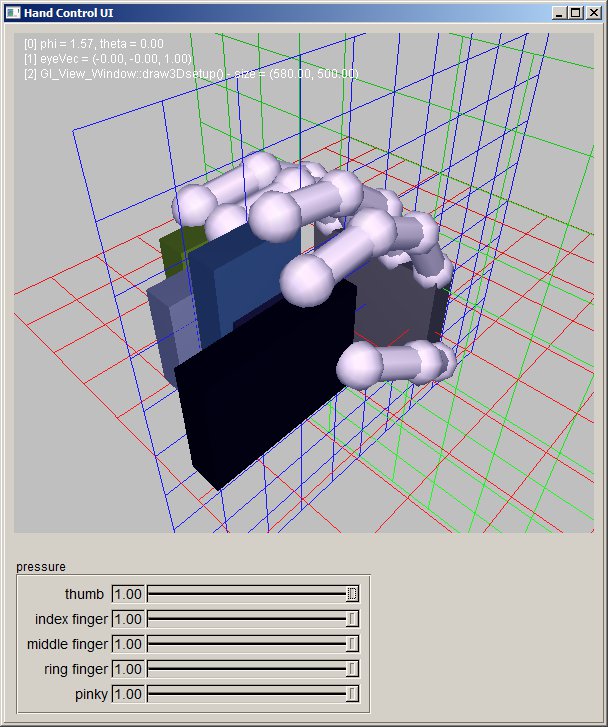
- Wire up the force sliders
- Index finger is done
- Thumb finger is done
- Ring finger is done
- Middle finger is done
- Pinky finger is done
- Added text within the 3D environment, partially to show Dong how it’s done, but also because it could be quite useful. It’s in the DrawableObject base class.
- Add collision detection
- Add force output display (Small GL windows, drawing only 2D?, slider?)
Tom DeVito 1.25.2012
Start: 10:00
- Made it so reciveData returns boolean. This way the state will only change if it receives successfully.
- After lots of troubleshooting, basic handshaking messages seem to be transferring properly.
- Changed test to be able to test sending data.
End: 6:00
Mike 1.25.2011
- Still waiting on the customer to suggest a beta test site, she said she would get back to me this week
- Still backing up the database / checking on the server every day
- Working with Kristi on the Documentation for Project Assistant, hopefully we can get it up on SVN and deploy a first draft at site this week
- Refreshed my memory on proper domain model diagrams and looked at a few free tools that do it, MySQLWorkbench seems to be the best, you can create your model/diagram then the program will create a database schema for you
- Spent the rest of the day looking at PDF generation libraries as it would be a handy for lots of different tasks: generating reports for visibility, generating reports for PPM, etc. There are several options:
- iText seems to be the most widely adopted. It has lots of documentation, examples and is pretty straightforward to use. It has a very complicated licensing / pricing structure though.
- PDFJet is a fairly established option with documentation, examples, and almost as many features as iText. It also has a simple flat commercial licensing fee of $295.
- PDF Clown is the last reasonable option I saw. It is the least developed of the three lacking even an automatic layout however it is completely open source.
Phil 1.25.12
8:30 – 5:30 FP
- More on the HandControlUi and RightHand proper.
- Added a clock to calculate elapsed time between frames for physically-based modeling.
- Got the basics of the hand working, but I need to rework the eyepoint/model control. Adding a popup menu to select the mode.
- This is a great source for FLTK coding examples (Erco’s FLTK Cheat Page)
- Done with the popup menu
- Adding the matrix analysis to get the position of the fingertips. Done for one finger. Need to add methods to store and access all the position information. May need orientation. If so then I could subtract the position from the current matrix, then multiply a vector by the resulting matrix.
- Might need this: http://www.cprogramming.com/tutorial/3d/rotationMatrices.html
Tom DeVito 1.24.2011
Start: 9:45
- Finished up changes to comutil and commgr
- Set up testing envioronment
- Going to send string messages across and print them to the console, after testing the more basic functions.
- Added some checks for null pointers so it doesn’t crash.
End: 6:00
Phil 1.24.12
8:30 – 2:30
- Well, I was hoping to use the MODELVIEW_Matrix to determine the orientation vector of the camera, but no luck. Time for classical spherical coordinate transforms. Transposing Y and Z, since OpenGl likes to have Y as the up vector.
- phi = angle from vertical, theta = angle from x axis
- z = cos(theta)*sin(phi)
- x = -sin(theta)*sin(phi)
- y = cos(theta)
- And that is now working. Note that we had to multiply the x component of the view vector by -1.
- Oooo – new shader book: http://www.packtpub.com/opengl-4-0-shading-language-cookbook/book
- Started on the HandControlUi fltk class.
Blog Search Tags
Many times I find it hard to find the information I want in to blog among the other entries. These tags will help to flag important information, to filter some of the more trivial stuff out(if you want more added to the list I will edit this post):
#NOTE: Something interesting that was found
#IMPROVE: Something that needs optimization
#FUTURE: Something that you want to remember to look into
#ATTENTION: Something that you want the other people on the project to read
#LIMITATION: For noting limiting factors such as memory constraints and what not
Tom DeVito 1.23.2012
Start: 10:30
- Working on changes to ComUtil. Since the basic communication should work independent of all the other stuff sent over the wire, the state and size of the potential incoming packet will be transferred in the smallest way possible.
- Made the following changes to ComMgr:
- Made send and recieve as simple as possible so ComUtil does all the heavy lifting
- Took out all buffers at this level. The pointer to the buffer is passed into the methods
- Changes to ComUtil:
- After trying to figure out how to do this and writing and rewriting the same part, I decided to model this class after the typical controller.
- This class does not inherit from controller because I wanted it to be lighter weight
- This class also runs in Master and Slave mode. In the case of this program the PC will always be flagged master and the Arduino will be the slave. The master controls the uid incrementing and the slave always echos.
- A large buffer will be broken into smaller packets
- decided since the buffer was a static size, it made sense to just send the packets in a way to match that size. Its currently send 4 packets of 128 bytes regardless of if its full or not. I can change this later if there are speed issues.
- Finishing up ComMgr(Arduino)
- Designated some flags for blog entries to make finding important information easier.
#IMPROVE: ComMgr(PC) needs a non-blocking receive
#IMPROVE: Send and recieve expect the whole 512 buffer split into 4 128byte parts. This can be done more efficiently if needed.


You must be logged in to post a comment.