Category Archives: Writing

Phil 1.8.18

7:00 – ASRC NASA

  • Software meeting at 9:00 in Beltsville
    • Products group
    • Attach an adder to the overhead?
    • 12.5% per bill on contract, so 10 contracts support one person
    • Currently covered for 3 months
    • AIMS 2019, TACLAMBDA have been approved (for the next 3 months?)
    • $300k from corporate across all groups.
    • Tasking for the next three months
    • Taking 2 modules out of A2P and making them compatible with AIMS.
    • Erik Velte runs TACLAMBDA
    • Evaluate the modules within A2P and migrate to TACLAMBDA (90% phil)
    • Some kind of machine learning for visa applications (RFP)?
    • Machine learning BAA?
    • We’re all ASTS, with TS signed by Eric/T
    • JPSS/NPP – changing from instrument data to telemetry
  • Sprint planning Meeting
  • Working on nn blog post

Phil 1.7.19

7:00 – 5:00 ASRC

  • Call Tim – The week looks dry
  • Schedule Physical – try tomorrow?
  • Continue with A guided tour through a dirt-simple “deep” neural network. Finished learning, started graphing
  • Downloaded the latest antibubbles and ran processing
  • More financial forecasting?
  • Sprint review?
    • Prepping by adding in all the things that I wound up doing
  • Worked on getting Aaron’s code working, which required installing MSVC 2017 which required me redistributing apps to clear up space on the SSD drive.

Phil 1.5.19

It seems to me that this might also be important for validating machine learning models. Getting a critical level for false classification might really help

  • The quest for an optimal alpha
    • Researchers who analyze data within the framework of null hypothesis significance testing must choose a critical “alpha” level, α, to use as a cutoff for deciding whether a given set of data demonstrates the presence of a particular effect. In most fields, α = 0.05 has traditionally been used as the standard cutoff. Many researchers have recently argued for a change to a more stringent evidence cutoff such as α = 0.01, 0.005, or 0.001, noting that this change would tend to reduce the rate of false positives, which are of growing concern in many research areas. Other researchers oppose this proposed change, however, because it would correspondingly tend to increase the rate of false negatives. We show how a simple statistical model can be used to explore the quantitative tradeoff between reducing false positives and increasing false negatives. In particular, the model shows how the optimal α level depends on numerous characteristics of the research area, and it reveals that although α = 0.05 would indeed be approximately the optimal value in some realistic situations, the optimal α could actually be substantially larger or smaller in other situations. The importance of the model lies in making it clear what characteristics of the research area have to be specified to make a principled argument for using one α level rather than another, and the model thereby provides a blueprint for researchers seeking to justify a particular α level.

Working more on A guided tour through a dirt-simple “deep” neural network

jaybookman

femexplore

Phil 12.28.18

7:00 – 4:30 ASRC NASA

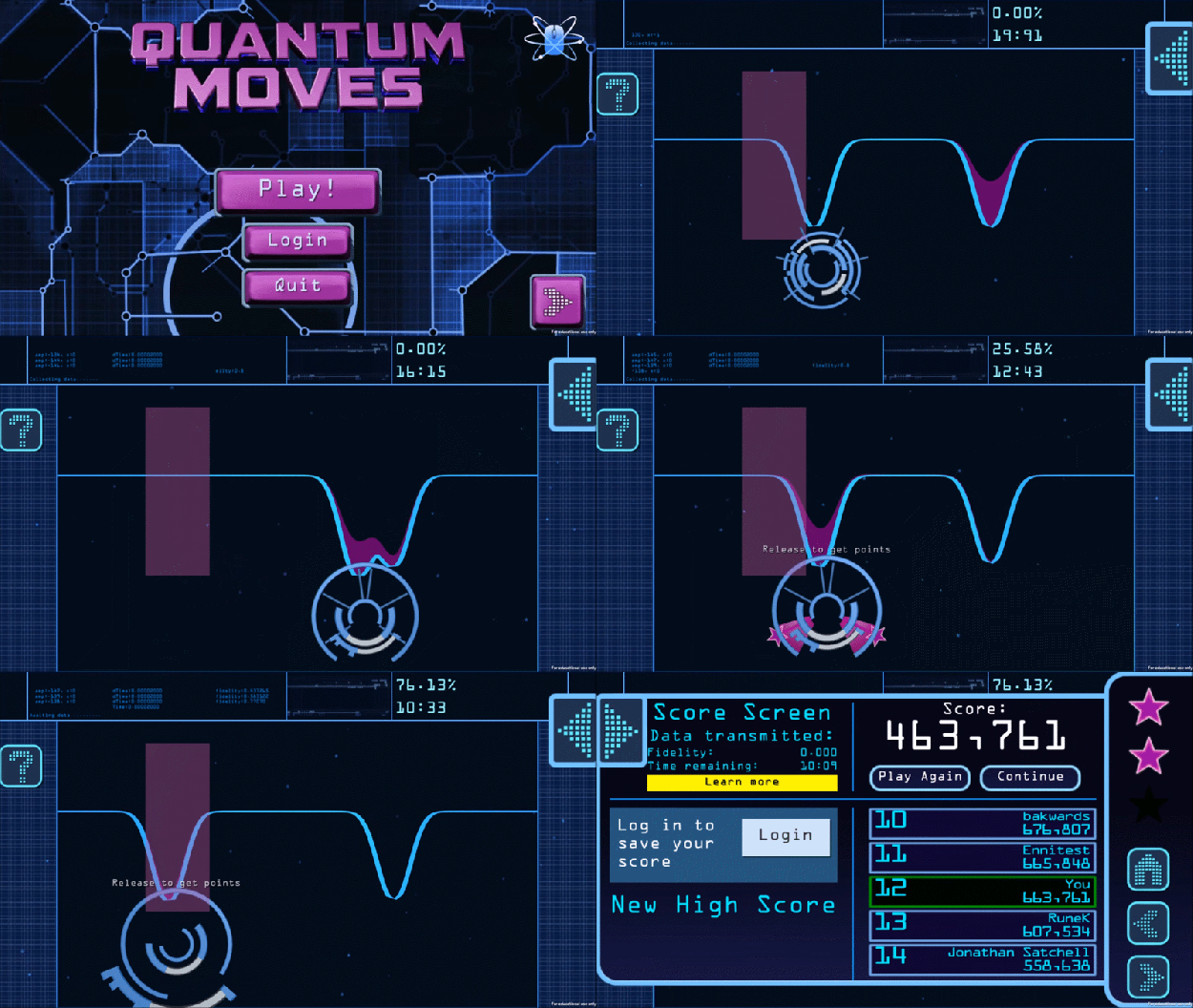
  • Human mind excels at quantum-physics computer game 3o6ozkvdtdarNDhGEw
  • Continuing on the proposal:
    • [Optional] What are your success metrics for the AI system (i.e., how will you know whether the system has succeeded or failed)?
      • Discuss the spectrum of success, from classification of behavior type by syntax patterns (LSTM) to human-based manifold learning (t-sne, xxx2vec, etc) for map generation, to development of new spatial neural frameworks, potentially based on grid neurons.
    • [Optional] What else we should know?
      • I want to say something about how this is based on animal studies, and how the idea of intelligence being expensive computation has to affect any kind of collective system. Still thinking about that.
      • Also, the economic power of maps, as discussed here
    • How will you sustain and grow the impact of this work beyond this grant? How could your project and its impact grow beyond what you’ve proposed in this application?
    • Need to add a brief description of each paper and include the venue and a link

Phil 12.27.18

7:00 – 11:00 PhD

  • How Much of the Internet Is Fake? Turns Out, a Lot of It, Actually.
    • Fake people with fake cookies and fake social-media accounts, fake-moving their fake cursors, fake-clicking on fake websites — the fraudsters had essentially created a simulacrum of the internet, where the only real things were the ads.
  • More proposal. With respect to bot traffic, there is standalone, monolithic and complex behaviors that can also be tracked and used to assess the underlying information. Adversarial herding is an example.
  • Ran out of steam. Hung up on these questions:
    • [Optional] What are your success metrics for the AI system (i.e., how will you know whether the system has succeeded or failed)?
      • Discuss the spectrum of success, from classification of behavior type by syntax patterns (LSTM) to human-based manifold learning (t-sne, xxx2vec, etc) for map generation, to development of new spatial neural frameworks, potentially based on grid neurons.
    • [Optional] What else we should know?
      • I want to say something about how this is based on animal studies, and how the idea of intelligence being expensive computation has to affect any kind of collective system. Still thinking about that.
      • Also, the economic power of maps, as discussed here
    • How will you sustain and grow the impact of this work beyond this grant? How could your project and its impact grow beyond what you’ve proposed in this application?
    • Need to add a brief description of each paper and include the venue and a link

Phil 12.26.18

7:00 – 9:00, 1:00 – 4:30

  • Proposal framing: more on global maps and navigating in common spaces. What this means to points of view, etc.
  • Good progress. Should finish tomorrow

Phil 12.24.18

PhD 7:00 – 3:00

Phil 11.26.18

7:00 – 5:00ASRC PhD

  • Had a thought that simulation plus diversity might be an effective way of increasing system resilience. This is based on the discussion of Apollo 13 in Normal Accidents
  • Start folding in content from simulation papers. Don’t worry about coherence yet
  • Start figuring out PHPbb
    • Working on the IRB form – done
    • Set user creation to admin-approved – done
    • Create easily identifiable players
      • Asra Rogueplayer
      • Ping Clericplayer
      • Valen Fighterplayer
      • Emmi MonkPlayer
      • Avia Bardplayer
      • Mirek Thiefplayer
      • Lino Magicplayer
      • Daz Dmplayer
    • Some notes on play by post
    • Added Aaron as a founder. He’s set up the overall structure: dungeon
    • Add easily identifiable content. Working. Set up the AntibubblesDungeon as a python project. I’m going to write a script generator that we will then use to paste in content. Then back up and download the database and run queries on it locally.

Phil 11.13.18

7:00 – 4:30

  • Bills
  • Get oil change kit from Bob’s
  • Antonio paper – done first complete pass
  • Sent Wayne a note to see if he knows of any online D&D research. My results are thin (see below)
  • Nice chat with Aaron about mapping in the D&D space. We reiterated that the goal of the first paper should be able to do the following:
    • map a linear dungeon
    • map the belief space adjacent to the dungeon (PC debates to consensus on how to proceed)
    • map the space in an open dungeon
    • map the belief space adjacent to an open dungeon
    • Additionally, we should be able to show that diversity (or lack of it) is recognizable. A mixed party should have a broader lexical set than a party of only fighters
    • We also realized that mapping could be a very good lens for digital anthropology. An interesting follow on paper could be an examination of how users run through a known dungeon, such as The Tomb of Horrors to see how the map generates, and to compare that to a version where the names of the items have been disguised so it’s not obvious that it’s the same game
  • Ordered these books. There doesn’t seem to be much else in the space, so I’m curious about the reference section
    • Second Person: Role-Playing and Story in Games and Playable Media (MIT Press)
      • Games and other playable forms, from interactive fictions to improvisational theater, involve role playing and story—something played and something told. In Second Person, game designers, authors, artists, and scholars examine the different ways in which these two elements work together in tabletop role-playing games (RPGs), computer games, board games, card games, electronic literature, political simulations, locative media, massively multiplayer games, and other forms that invite and structure play.  Second Person—so called because in these games and playable media it is “you” who plays the roles, “you” for whom the story is being told—first considers tabletop games ranging from Dungeons & Dragons and other RPGs with an explicit social component to Kim Newman’s Choose Your Own Adventure-style novel Life’s Lottery and its more traditional author-reader interaction. Contributors then examine computer-based playable structures that are designed for solo interaction—for the singular “you”—including the mainstream hit Prince of Persia: The Sands of Time and the genre-defining independent production Façade. Finally, contributors look at the intersection of the social spaces of play and the real world, considering, among other topics, the virtual communities of such Massively Multiplayer Online Role Playing Games (MMORPGs) as World of Warcraft and the political uses of digital gaming and role-playing techniques (as in The Howard Dean for Iowa Game, the first U.S. presidential campaign game).
    • Third Person: Authoring and Exploring Vast Narratives (The MIT Press)
      • The ever-expanding capacities of computing offer new narrative possibilities for virtual worlds. Yet vast narratives—featuring an ongoing and intricately developed storyline, many characters, and multiple settings—did not originate with, and are not limited to, Massively Multiplayer Online Games. Thomas Mann’s Joseph and His Brothers, J. R. R. Tolkien’s Lord of the Rings, Marvel’s Spiderman, and the complex stories of such television shows as Dr. Who, The Sopranos, and Lost all present vast fictional worlds. Third Person explores strategies of vast narrative across a variety of media, including video games, television, literature, comic books, tabletop games, and digital art. The contributors—media and television scholars, novelists, comic creators, game designers, and others—investigate such issues as continuity, canonicity, interactivity, fan fiction, technological innovation, and cross-media phenomena. Chapters examine a range of topics, including storytelling in a multiplayer environment; narrative techniques for a 3,000,000-page novel; continuity (or the impossibility of it) in Doctor Who; managing multiple intertwined narratives in superhero comics; the spatial experience of the Final Fantasy role-playing games; World of Warcraft adventure texts created by designers and fans; and the serial storytelling of The Wire. Taken together, the multidisciplinary conversations in Third Person, along with Harrigan and Wardrip-Fruin’s earlier collections First Person and Second Person, offer essential insights into how fictions are constructed and maintained in very different forms of media at the beginning of the twenty-first century.
  • A Support System to Accumulate Interpretations of Multiple Story Timelines
    • The story base interpretation is subjectively summarised and segmented from the first-person viewpoint. However, we often need to objectively represent an entire image by integrated knowledge. Yet, this is a difficult task. We proposed a novel approach, named the synthetic evidential study (SES), for understanding and augmenting collective thought processes through substantiated thought by interactive media. In this study, we investigated the kind of data that can be obtained through the SES sessions as interpretation archives and whether the database is useful to understand multiple story timelines. For the purpose, we designed a machine-readable interpretation data format and developed support systems to create and provide data that are easy to understand. We conducted an experiment using the simulation of the projection phase in SES sessions. From the results, we suggested that a “meta comment” which was deepened interpretation comment by the others in the interpretation archives to have been posted when it was necessary to consider other participants’ interpretation to broaden their horizons before posting the comment. In addition, the construction of networks to represent the relationships between the interpretation comments enabled us to suggest the important comments by using the degree centrality.

Phil 11.12.18

7:00 – 7:00 ASRC PhD

  • Call Tim Ellis – done
  • Tags – done
  • Bills – nope, including MD EV paperwork -done
  • Get oil change kit from Bob’s – closed
  • Fika – done
  • Finish Similar neural responses predict friendship – Done!
  • Discrete hierarchical organization of social group sizes
    • The ‘social brain hypothesis’ for the evolution of large brains in primates has led to evidence for the coevolution of neocortical size and social group sizes, suggesting that there is a cognitive constraint on group size that depends, in some way, on the volume of neural material available for processing and synthesizing information on social relationships. More recently, work on both human and non-human primates has suggested that social groups are often hierarchically structured. We combine data on human grouping patterns in a comprehensive and systematic study. Using fractal analysis, we identify, with high statistical confidence, a discrete hierarchy of group sizes with a preferred scaling ratio close to three: rather than a single or a continuous spectrum of group sizes, humans spontaneously form groups of preferred sizes organized in a geometrical series approximating 3–5, 9–15, 30–45, etc. Such discrete scale invariance could be related to that identified in signatures of herding behaviour in financial markets and might reflect a hierarchical processing of social nearness by human brains.
  • Work on Antonio’s paper – good progress
  • Aaron added a lot of content to Belief Spaces, and we got together to discuss. Probably the best thing to come out of the discussion was an approach to the dungeons that at one end is an acyclic, directed, linear graph of connected nodes. The map will be a line, with any dilemma discussions connected with the particular nodes. At the other end is an open environment. In between are various open and closed graphs that we can classify with some level of complexity.
  • One of the things that might be interesting to examine is the distance between nodes, and how that affects behavior
  • Need to mention that D&D are among the oldest “digital residents” of the internet, with decades-old artifacts.

Phil 11.7.18

Let the House Subcommittee investigations begin! Also, better redistricting?

7:00 – 5:00 ASRC PhD/BD

  • Rather than Deep Learning with Keras, I’m starting on Grokking Deep Learning. I need better grounding
    • Installed Jupyter
  • After lunch, send follow-up emails to the technical POCs. This will be the basis for the white paper: Tentative findings/implications for design. Modify it on the blog page first and then use to create the LaTex doc. Make that one project, with different mains that share overlapping content.
  • Characterizing Online Public Discussions through Patterns of Participant Interactions
    • Public discussions on social media platforms are an intrinsic part of online information consumption. Characterizing the diverse range of discussions that can arise is crucial for these platforms, as they may seek to organize and curate them. This paper introduces a computational framework to characterize public discussions, relying on a representation that captures a broad set of social patterns which emerge from the interactions between interlocutors, comments and audience reactions. We apply our framework to study public discussions on Facebook at two complementary scales. First, we use it to predict the eventual trajectory of individual discussions, anticipating future antisocial actions (such as participants blocking each other) and forecasting a discussion’s growth. Second, we systematically analyze the variation of discussions across thousands of Facebook sub-communities, revealing subtle differences (and unexpected similarities) in how people interact when discussing online content. We further show that this variation is driven more by participant tendencies than by the content triggering these discussions.
  • More latent space flocking from Innovation Hub
    • You Share Everything With Your Bestie. Even Brain Waves.
      •  Scientists have found that the brains of close friends respond in remarkably similar ways as they view a series of short videos: the same ebbs and swells of attention and distraction, the same peaking of reward processing here, boredom alerts there. The neural response patterns evoked by the videos — on subjects as diverse as the dangers of college football, the behavior of water in outer space, and Liam Neeson trying his hand at improv comedy — proved so congruent among friends, compared to patterns seen among people who were not friends, that the researchers could predict the strength of two people’s social bond based on their brain scans alone.

    • Similar neural responses predict friendship
      • Human social networks are overwhelmingly homophilous: individuals tend to befriend others who are similar to them in terms of a range of physical attributes (e.g., age, gender). Do similarities among friends reflect deeper similarities in how we perceive, interpret, and respond to the world? To test whether friendship, and more generally, social network proximity, is associated with increased similarity of real-time mental responding, we used functional magnetic resonance imaging to scan subjects’ brains during free viewing of naturalistic movies. Here we show evidence for neural homophily: neural responses when viewing audiovisual movies are exceptionally similar among friends, and that similarity decreases with increasing distance in a real-world social network. These results suggest that we are exceptionally similar to our friends in how we perceive and respond to the world around us, which has implications for interpersonal influence and attraction.
    • Brain-to-Brain coupling: A mechanism for creating and sharing a social world
      • Cognition materializes in an interpersonal space. The emergence of complex behaviors requires the coordination of actions among individuals according to a shared set of rules. Despite the central role of other individuals in shaping our minds, most cognitive studies focus on processes that occur within a single individual. We call for a shift from a single-brain to a multi-brain frame of reference. We argue that in many cases the neural processes in one brain are coupled to the neural processes in another brain via the transmission of a signal through the environment. Brain-to-brain coupling constrains and simplifies the actions of each individual in a social network, leading to complex joint behaviors that could not have emerged in isolation.
  • Started reading Similar neural responses predict friendship

Phil 11.5.18

7:00- 4:30 ASRC PhD

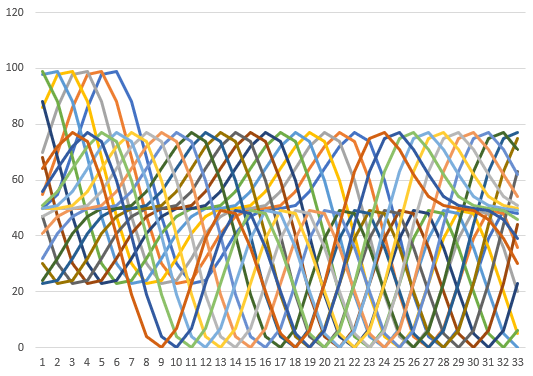
  • Make integer generator by scaling and shifting the floating point generator to the desired values and then truncating. It would be fun to read in a token list and have the waveform be words
    • Done with the int waveform. This is an integer waveform of the function
      math.sin(xx)*math.sin(xx/2.0)*math.cos(xx/4.0)

      set on a range from 0 – 100:

    •  IntWaves
    • And here’s the unmodified floating-point version of the same function:
    • FloatWaves
    • Here’s the same function as words:
      #confg: {"function":math.sin(xx)*math.sin(xx/2.0)*math.cos(xx/4.0), "rows":100, "sequence_length":20, "step":1, "delta":0.4, "type":"floating_point"}
      routed, traps, thrashing, fifteen, ultimately, dealt, anyway, apprehensions, boats, job, descended, tongue, dripping, adoration, boats, routed, routed, strokes, cheerful, charleses, 
      traps, thrashing, fifteen, ultimately, dealt, anyway, apprehensions, boats, job, descended, tongue, dripping, adoration, boats, routed, routed, strokes, cheerful, charleses, travellers, 
      thrashing, fifteen, ultimately, dealt, anyway, apprehensions, boats, job, descended, tongue, dripping, adoration, boats, routed, routed, strokes, cheerful, charleses, travellers, unsuspected, 
      fifteen, ultimately, dealt, anyway, apprehensions, boats, job, descended, tongue, dripping, adoration, boats, routed, routed, strokes, cheerful, charleses, travellers, unsuspected, malingerer, 
      ultimately, dealt, anyway, apprehensions, boats, job, descended, tongue, dripping, adoration, boats, routed, routed, strokes, cheerful, charleses, travellers, unsuspected, malingerer, respect, 
      dealt, anyway, apprehensions, boats, job, descended, tongue, dripping, adoration, boats, routed, routed, strokes, cheerful, charleses, travellers, unsuspected, malingerer, respect, aback, 
      anyway, apprehensions, boats, job, descended, tongue, dripping, adoration, boats, routed, routed, strokes, cheerful, charleses, travellers, unsuspected, malingerer, respect, aback, vair', 
      apprehensions, boats, job, descended, tongue, dripping, adoration, boats, routed, routed, strokes, cheerful, charleses, travellers, unsuspected, malingerer, respect, aback, vair', wraith, 
      boats, job, descended, tongue, dripping, adoration, boats, routed, routed, strokes, cheerful, charleses, travellers, unsuspected, malingerer, respect, aback, vair', wraith, bare, 
      job, descended, tongue, dripping, adoration, boats, routed, routed, strokes, cheerful, charleses, travellers, unsuspected, malingerer, respect, aback, vair', wraith, bare, creek, 
      descended, tongue, dripping, adoration, boats, routed, routed, strokes, cheerful, charleses, travellers, unsuspected, malingerer, respect, aback, vair', wraith, bare, creek, descended, 
      tongue, dripping, adoration, boats, routed, routed, strokes, cheerful, charleses, travellers, unsuspected, malingerer, respect, aback, vair', wraith, bare, creek, descended, assortment, 
      dripping, adoration, boats, routed, routed, strokes, cheerful, charleses, travellers, unsuspected, malingerer, respect, aback, vair', wraith, bare, creek, descended, assortment, flashed, 
      adoration, boats, routed, routed, strokes, cheerful, charleses, travellers, unsuspected, malingerer, respect, aback, vair', wraith, bare, creek, descended, assortment, flashed, reputation, 
      boats, routed, routed, strokes, cheerful, charleses, travellers, unsuspected, malingerer, respect, aback, vair', wraith, bare, creek, descended, assortment, flashed, reputation, guarded, 
      routed, routed, strokes, cheerful, charleses, travellers, unsuspected, malingerer, respect, aback, vair', wraith, bare, creek, descended, assortment, flashed, reputation, guarded, tempers, 
      routed, strokes, cheerful, charleses, travellers, unsuspected, malingerer, respect, aback, vair', wraith, bare, creek, descended, assortment, flashed, reputation, guarded, tempers, partnership, 
      strokes, cheerful, charleses, travellers, unsuspected, malingerer, respect, aback, vair', wraith, bare, creek, descended, assortment, flashed, reputation, guarded, tempers, partnership, bare, 
      cheerful, charleses, travellers, unsuspected, malingerer, respect, aback, vair', wraith, bare, creek, descended, assortment, flashed, reputation, guarded, tempers, partnership, bare, count, 
      charleses, travellers, unsuspected, malingerer, respect, aback, vair', wraith, bare, creek, descended, assortment, flashed, reputation, guarded, tempers, partnership, bare, count, descended, 
      travellers, unsuspected, malingerer, respect, aback, vair', wraith, bare, creek, descended, assortment, flashed, reputation, guarded, tempers, partnership, bare, count, descended, dashed, 
      unsuspected, malingerer, respect, aback, vair', wraith, bare, creek, descended, assortment, flashed, reputation, guarded, tempers, partnership, bare, count, descended, dashed, ears, 
      malingerer, respect, aback, vair', wraith, bare, creek, descended, assortment, flashed, reputation, guarded, tempers, partnership, bare, count, descended, dashed, ears, q, 


  • Started LSTMs again, using this example using Alice in Wonderland
  • Aaron and T in all day discussions with Kevin about NASA/NOAA. Dropped in a few times. NASA is airgapped, but you can bring code in and out. Bringing code in requires a review.
  • Call the Army BAA people. We need white paper templates and a response for Dr. Palazzolo.
  • Finish and submit 810 reviews tonight. Done.
  • This is important for the DARPA and Army BAAs: The geographic embedding of online echo chambers: Evidence from the Brexit campaign
    • This study explores the geographic dependencies of echo-chamber communication on Twitter during the Brexit campaign. We review the evidence positing that online interactions lead to filter bubbles to test whether echo chambers are restricted to online patterns of interaction or are associated with physical, in-person interaction. We identify the location of users, estimate their partisan affiliation, and finally calculate the distance between sender and receiver of @-mentions and retweets. We show that polarized online echo-chambers map onto geographically situated social networks. More specifically, our results reveal that echo chambers in the Leave campaign are associated with geographic proximity and that the reverse relationship holds true for the Remain campaign. The study concludes with a discussion of primary and secondary effects arising from the interaction between existing physical ties and online interactions and argues that the collapsing of distances brought by internet technologies may foreground the role of geography within one’s social network.
  • Also important:
    • How to Write a Successful Level I DHAG Proposal
      • The idea behind a Level I project is that it can be “high risk/high reward.” Put another way, we are looking for interesting, innovative, experimental, new ideas, even if they have a high potential to fail. It’s an opportunity to figure things out so you are better prepared to tackle a big project. Because of the relatively low dollar amount (no more than $50K), we are willing to take on more risk for an idea with lots of potential. By contrast, at the Level II and especially at the Level III, there is a much lower risk tolerance; the peer reviewers expect that you’ve already completed an earlier start-up or prototyping phase and will want you to convince them your project is ready to succeed.
  • Tracing a Meme From the Internet’s Fringe to a Republican Slogan
    • This feedback loop is how #JobsNotMobs came to be. In less than two weeks, the three-word phrase expanded from corners of the right-wing internet onto some of the most prominent political stages in the country, days before the midterm elections.
  • Effectiveness of gaming for communicating and teaching climate change
    • Games are increasingly proposed as an innovative way to convey scientific insights on the climate-economic system to students, non-experts, and the wider public. Yet, it is not clear if games can meet such expectations. We present quantitative evidence on the effectiveness of a simulation game for communicating and teaching international climate politics. We use a sample of over 200 students from Germany playing the simulation game KEEP COOL. We combine pre- and postgame surveys on climate politics with data on individual in-game decisions. Our key findings are that gaming increases the sense of personal responsibility, the confidence in politics for climate change mitigation, and makes more optimistic about international cooperation in climate politics. Furthermore, players that do cooperate less in the game become more optimistic about international cooperation but less confident about politics. These results are relevant for the design of future games, showing that effective climate games do not require climate-friendly in-game behavior as a winning condition. We conclude that simulation games can facilitate experiential learning about the difficulties of international climate politics and thereby complement both conventional communication and teaching methods.
    • This reinforces the my recent thinking that games may be a fourth, distinct form of human sociocultural communication

Phil 10.29.18

7:00 – 5:00 ASRC PhD

  • This looks like a Big Deal from Google – Working together to apply AI for social good
    • Google.org is issuing an open call to organizations around the world to submit their ideas for how they could use AI to help address societal challenges. Selected organizations will receive support from Google’s AI experts, Google.org grant funding from a $25M pool, credit and consulting from Google Cloud, and more.
    • We look forward to receiving your application on or before 11:59 p.m. PT on January 22, 2019, and we encourage you to apply early given that we expect high volume within the last few hours of the application window. Thank you!
    • Application Guide
    • Application form (can’t save, compose offline using guide, above)
  • Finished my writeup on Meltdown
  • Waiting for a response from Antonio
  • Meeting with Don at 9:00 to discuss BAA partnership.
    • Don is comfortable with being PI or co-PI, whichever works best. When we call technical POCs, we speak on his behalf
    • We discussed how he could participate with the development of theoretical models based on signed graph Laplacians creating structures that can move in belief space. He thinks the idea has merit, and can put in up to 30% of his time on mathematical models and writing
    • ASRC has already partnered with UMBC. ASRC would sub to UMBC
    • Ordinarily, IP is distributed proportional to the charged hours
    • Don has access to other funding vehicles that can support the Army BAA, but this would make things more complicated. These should be discussed if we can’t make a “clean” agreement that meets our funding needs
  • Pinged Brian about his defense.
  • Some weekend thoughts
    • Opinion dynamics systems describe how communication within a network occurs, but disregards the motion of the network as a whole. In cases when the opinions converge, the network is stiff.
    • Graph laplacians could model “othering” by having negative weights. It looks like these are known as signed laplacians, and useful to denote difference. The trick is to discover the equations of motion. How do you model a “social particle”?
  • Just discovered the journal Swarm Intelligence
    • Swarm Intelligence is the principal peer reviewed publication dedicated to reporting research and new developments in this multidisciplinary field. The journal publishes original research articles and occasional reviews on theoretical, experimental, and practical aspects of swarm intelligence. It offers readers reports on advances in the understanding and utilization of systems that are based on the principles of swarm intelligence. Emphasis is given to such topics as the modeling and analysis of collective biological systems; application of biological swarm intelligence models to real-world problems; and theoretical and empirical research in ant colony optimization, particle swarm optimization, swarm robotics, and other swarm intelligence algorithms. Articles often combine experimental and theoretical work.
  • I think it’s time to start ramping up on the text generation!
      • Updated my home box to tensorflow 1.11.0. Testing to see if it still works using the Deep Learning with Keras simple_nueral_net.py example. Hasn’t broken (yet…), but is taking a long time… Worked! And it’s much faster the second time. Don’t know why that is and can’t find anything online that talks to that.
        Loss: 0.5043802047491074
        Accuracy: 0.8782
        Time =  211.42629722093085
      • Found this keras example for generating Nietsche


    • Trying it out. This may be a overnight run… But it is running.
  • Had a good discussion with Aaron about how mapmaking could be framed as an ML problem. More writeup tomorrow.