Category Archives: Projects

Phil 2.23.15

7:30 – 2:30 SR

  • Working on scheduling a testing meeting
  • After restarting my deployment test client, all the weird FF errors are gone. The texture map still wouldn’t load, so I tried a smaller one. That worked fine. So no big texture files until we know what’s going on. Also, the drawing context appears to get lost when the screen gets locked.
  • Worked on migrating WebGLCanvas and WebGLComponent to AngularTS. Thinking about how to share the canvas scope with components.

Dong Shin 02.20.2015

  • support on site…
    • new presentation data
      • incorrect Obligations calculations – need to look at Reqonciler
    • new truancy report for FY15 – need to modify so that no changes are required….
    • removed all VizTool POCs from FY13 Budget Centers

Phil 2.19.15

8:00 – 4:00 SR

  • Looks like the Angular/TypeScript/WebGL code will probably work on the production machines, based on preliminary tests. Next is to try a full deployment onto the test server. Will need:
    • Angular libraries (or just angular/angular.js)
    • threejs libraries (or just threejs/build/three.js)
    • Test code with assets (basically the whole AngularThreeTS directory
  • Updated month for truancy report. We really need to automate this. Also, Lenny wants an FY15 report.
  • Adding an overlay plane turned out to be pretty damn hard, basically because Angular doesn’t want this to be easy, I think. Anyway, here’s how it’s done:
  • Have a variable for your context. I don’t seem to need it, but I’ve grabbed the elements for the WebGL and overlay as well:
glElement:HTMLCanvasElement;
overlayElement:HTMLCanvasElement;
overlayContext:CanvasRenderingContext2D;
  • Set up the WebGLRenderer and the overlay. Note that I have to set attributes using the following styles:
.glContainer {
    position: absolute;
    z-index: 0;
}

.overlayContainer {
    position: absolute;
    z-index: 1;
}
  • Now use the styles to set up the elements:
this.renderer = new THREE.WebGLRenderer({antialias: true});
this.renderer.setClearColor(this.blackColor, 1);
this.renderer.setSize(this.contW, this.contH);

// element is provided by the angular directive
this.renderer.domElement.setAttribute("class", "glContainer");
this.glElement = this.myElements[0].appendChild(this.renderer.domElement);

//this.overlayNode = angular.element(divString);
this.overlayElement = document.createElement("canvas");
this.overlayElement.setAttribute("class", "overlayContainer");
this.myElements[0].appendChild(this.overlayElement);
this.overlayContext = this.overlayElement.getContext("2d");
  • The 3D and 2D rendering is then done as follows:
draw2D = (ctx:CanvasRenderingContext2D):void =>{
   var canvas:HTMLCanvasElement = ctx.canvas;
   canvas.width = this.contW;
   canvas.height = this.contH;
   ctx.clearRect(0, 0, canvas.width, canvas.height);
   ctx.font = '12px "Times New Roman"';
   ctx.fillStyle = 'rgba( 255, 255, 255, 1)'; // Set the letter color
   ctx.fillText("Hello, framecount: "+this.frameCount, 10, 20);
};

render = ():void=> {
   // do the 3D rendering
   this.camera.lookAt(this.scene.position);
   this.renderer.render(this.scene, this.camera);
   this.frameCount++;

   this.draw2D(this.overlayContext);
};

Phil 2.18.2014

7:00 – 4:00 SR

  • ITK timesheet!
  • Updated JavaUtils.FileUtils to handle selecting a directory. Still need to check in.
  • Installed new certs on the test server
  • Working on integrating threejs with the framework.
  • Got a bunch of 3D directives running in ng-repeat.
  • Added texture maps and an assets folder. Each directive is currently loading its own copy of the texture. And it looks like it has to be that way. If I try to point at a common material, I get the following error: WebGL: INVALID_OPERATION: useProgram: object not from this context
  • Tested across the major browsers, including Chrome and Safari on the iPhone! Check it out here.
  • Working on making some threeJS base classes. This pattern seems to work…
module WGLA1_dirtv {
   // The base class for the webGL 'canvas' has the scene, root object, basic lights and a camera
   class webGLBase {
      myScope:any;
      myElements:any;
      myAttrs:any;

      frameCount:number;
      mouseX:number;
      mouseY:number;
      contW:number;
      contH:number;
      windowHalfX:number;
      windowHalfY:number;
      camera:THREE.PerspectiveCamera;
      scene:THREE.Scene;
      sphere:THREE.Mesh;
      light:THREE.DirectionalLight;
      renderer:THREE.WebGLRenderer;
      redColor:THREE.Color;
      whiteColor:THREE.Color;
      greyColor:THREE.Color;

      constructor(scope:any, element:any, attrs:any) {
         this.myScope = scope;
         this.myElements = element;
         this.myAttrs = attrs;

         this.frameCount = 0;
         this.mouseX = 0;
         this.mouseY = 0;
         this.contW = scope.width;
         this.contH = scope.height;
         this.windowHalfX = this.contW / 2;
         this.windowHalfY = this.contH / 2;
      }


      public init = ():void => {
         this.myElements[0].addEventListener('mousemove', this.onDocumentMouseMove, false);

         this.redColor = new THREE.Color(0xff0000);
         this.whiteColor = new THREE.Color(0xffffff);
         this.greyColor = new THREE.Color(0x080808);

         // Scene
         this.scene = new THREE.Scene();

         // camera
         this.camera = new THREE.PerspectiveCamera(45, this.contW / this.contH, 0.1, 10000);
         // Position is -20 along the Z axis and look at the origin
         this.camera.position = new THREE.Vector3(0, 0, 10);
         this.camera.lookAt(new THREE.Vector3(0, 0, 0));

         var sphereGeometry = new THREE.SphereGeometry(5, 20, 20);

         // This time we create a Phong shader material and provide a texture.
         var sphereMaterial = new THREE.MeshPhongMaterial(
            {
               map: THREE.ImageUtils.loadTexture("assets/earth-day.jpg")
            }
         );

         // Now make a THREE.Mesh using the geometry and a shader
         this.sphere = new THREE.Mesh(sphereGeometry, sphereMaterial);

         // And put it at the origin
         this.sphere.position = new THREE.Vector3(0, 0, 0);

         // Add it to the scene and render the scene using the Scene and Camera objects
         this.scene.add(this.sphere);

         // Lighting
         this.light = new THREE.DirectionalLight(0xffffff);
         this.light.position.set(10, 10, 10);
         this.scene.add(this.light);
         this.scene.add(new THREE.AmbientLight(this.greyColor.getHex()));
         /****/
         this.renderer = new THREE.WebGLRenderer({antialias: true});
         this.renderer.setClearColor(this.whiteColor, 1);
         this.renderer.setSize(this.contW, this.contH);

         // element is provided by the angular directive
         this.myElements[0].appendChild(this.renderer.domElement);

         this.renderer.clear();
      };

      onDocumentMouseMove = (event:MouseEvent):void => {
         this.mouseX = ( event.clientX - this.windowHalfX );
         this.mouseY = ( event.clientY - this.windowHalfY );
      };

      render = ():void=> {
         //camera.position.x = ( mouseX - camera.position.x ) * 0.05;
         //camera.position.y = ( - mouseY - camera.position.y ) * 0.05;

         this.camera.lookAt(this.scene.position);
         this.renderer.render(this.scene, this.camera);
         this.frameCount++;
         //console.log("frameCount = "+frameCount);
      };

      animate = () => {
         this.sphere.rotation.y = this.frameCount * 0.01;
         requestAnimationFrame(this.animate);
         this.render();
      };
   }

   // The webGL directive. Instantiates a webGlBase-derived class for each scope
   export class ngWebgl {
      private myDirective:ng.IDirective;

      constructor() {
         this.myDirective = null;
      }

      private linkFn = (scope:any, element:any, attrs:any) => {
         scope.webGlBase = new webGLBase(scope, element, attrs);
         scope.webGlBase.init();
         scope.webGlBase.animate();
      };

      public ctor = ():ng.IDirective => {
         if (!this.myDirective) {
            this.myDirective = {
               restrict: 'A',
               scope: {
                  'width': '=',
                  'height': '=',
                  'fillcontainer': '=',
                  'scale': '=',
                  'materialType': '='
               },
               link: this.linkFn
            }
         }
         return this.myDirective;
      }
   }
}
  • As you can see, the weGL parts are in their own class (webGlBase), and are instanced for each scope in (ngWebgl). Tomorrow, I’m going to start pulling code over from my YUI classes and rebuilding them.

Dong Shin 02.17.2015

  • working off items from Lenny/Chris
    • change the order of buttons
    • POC’s should be user specfic, can be used from other FRs added by the same user
    • ISR PMO panel
      • Only admins can enter ISR PMO information
      • change ISR PMO POC to ISR PM
      • Req # is text, not drop down
      • Prior Req # comes from FA database
    • Project Description panel
      • add Project Lab PM after Project Lab
      • add text – Select the Service this project is supporting
    • Funding Description
      • Mailing Address not required from EA/REQ
    • Funding Details
      • hide Direct Cite/Reimbursable for EA/REQ
      • remove FY 10 from Appropriations
      • move Funding Type from Funding Description panel (copy?)
    • Contract Process
      • change FR Processing to Invoicing Processing Procedures
        • ACRN, Batch Processing, FIFO, Other
      • remove 100% funds required
      • change Explanation if Other to Invoice Instruction
    • Funding Requirement
      • single entry not multiple
      • remove Justification
      • Date Needed, Amount Needed, 100% Required to Obligate (Yes or No)
    • Contract Labor, Government Labor, Travel, Equipment/Material
      • add Contract # from Contract Details
      • Yes or No
    • Outlay Plan
      • remove Month 13-15
      • auto fill rest when 100%
      • check if value is > amount from Funding Details
    • Service Fee
      • Yes or No
      • Justification is textArea
    • FFRDC
      • Yes or No
      • hide when no
    • Contract Details
      • Yes or No
      • add Are any of the funds being required being placed on contract?

Dong Shin 02.14.2015

  • checking off notes items…..
  • deployed new FR and reviewed with Lenny
  • notes from Lenny/Chris
    • change the order of buttons
    • POC’s should be user specfic, can be used from other FRs added by the same user
    • ISR PMO panel
      • Only admins can enter ISR PMO information
      • change ISR PMO POC to ISR PM
      • Req # is text, not drop down
      • Prior Req # comes from FA database
    • Project Description panel
      • add Project Lab PM after Project Lab
      • add text – Select the Service this project is supporting
    • Funding Description
      • Mailing Address not required from EA/REQ
    • Funding Details
      • hide Direct Cite/Reimbursable for EA/REQ
      • remove FY 10 from Appropriations
      • move Funding Type from Funding Description panel (copy?)
    • Contract Process
      • change FR Processing to Invoicing Processing Procedures
        • ACRN, Batch Processing, FIFO, Other
      • remove 100% funds required
      • change Explanation if Other to Invoice Instruction
    • Funding Requirement
      • single entry not multiple
      • remove Justification
      • Date Needed, Amount Needed, 100% Required to Obligate (Yes or No)
    • Contract Labor, Government Labor, Travel, Equipment/Material
      • add Contract # from Contract Details
      • Yes or No
    • Outlay Plan
      • remove Month 13-15
      • auto fill rest when 100%
      • check if value is > amount from Funding Details
    • Service Fee
      • Yes or No
      • Justification is textArea
    • FFRDC
      • Yes or No
      • hide when no
    • Contract Details
      • Yes or No
      • add Are any of the funds being required being placed on contract?

Phil 2.13.15

8:00 – 4:00 SR

  • Deploy new test FR today.
  • I think I realized the problem that we were having importing the cert yesterday. We need the original jks file from the keytool -genkey command. That (I believe) contains the public key that is used to create the certificate. From Oracle: If the public key in the certificate reply matches the user’s public key already stored with under alias, the old certificate chain is replaced with the new certificate chain in the reply. The old chain can only be replaced if a valid keypass, the password used to protect the private key of the entry, is supplied. If no password is provided, and the private key password is different from the keystore password, the user is prompted for it.
  • Change LoginPanel directive to use instanced TypeScript Object. Done, and it went quite well. The only thing to note is that fat arrow notation has to happen inside *every* function inside the scope (and as a quick aside, what happens if you break the chain? Can you have two scopes if you nest function(){}/()=>{} in the right way?). The compiler warns you about ambiguous ‘this’ cases, which is nice. It can look kins of wierd, though:
then( ():void => {
   scope.isValid = this.loginObj.response;
   if (this.loginObj.response) {
      scope.speak('new password for ' + this.loginObj.name + ' accepted');
   } else {
      scope.speak('new password for ' + this.loginObj.name + ' rejected');
   }
}, this.errorResponse);
  • Start porting threeJS canvas framework today.
    • Got the base module controller framework set up
    • Imported definatelytyped for threejs, which barfed a bit.
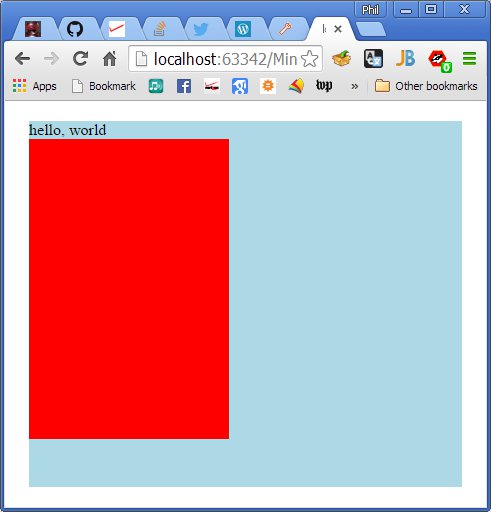
    • Discovered sizing relative to viewport here, which means that the following will fill up the browser window with a 5% whitespace border!
.glWindow{
    position: absolute;
    box-sizing: border-box;
    top: 5vh;
    left: 5vw;
    width: 90vw;
    height: 90vh;
    background-color: red;
}
  • While looking for how to get a canvas element, I found a (good?) TypeScript/WebGL series of posts here.
  • Yay!

helloGL

Dong Shin 02.11.2015

  • working on FR
    • set all initial number to null so that validation works on 0
    • working on adding multiple pocs
      • added new table, point_of_contacts, to database, modified funding_request table
      • added server code
      • adding client

Phil 2.11.14

8:00 – 2:30 SR

  • Alert the media – there are no problems with the production system at all today. no requests, no messages, no nothing.
  • Angular. Need to drill down further into the ramifications of declaring functions using the public/private foo = (arg) =>{}; How does this manifest in EcmaScript6? Does this work with a static declaration? What about typing the return value? For that matter, do these methods inherit properly? I’m going to create a inherit5 file and try these things. In a perfect world, this pattern should collapse the problems with Factory and Directive.
    • EcmaScript 6: The Mozilla Developer Network discusses fat arrows here. The part about ‘lexical this is worth paraphrasing here:
      • Until arrow functions, every new function defined its own this value (a new object in case of a constructor, undefined in strict mode function calls, the context object if the function is called as an “object method”, etc.). This proved to be annoying with an object-oriented style of programming. In ECMAScript 3/5, this issue was fixed by assigning the value in this (e.g. self) to a variable that could be closed over. Arrow functions capture the this value of the enclosing context, so the following code works as expected.
function Person(){
  this.age = 0;

  setInterval(() => {
    this.age++; // |this| properly refers to the person object
  }, 1000);
}

var p = new Person();
      • So, according to this and as long as the proposal doesn’t change too much, I think we’re on stable ground
      • Set up Inherit5.html and Inherit5.ts. Pretty much everything works in the ‘best case’ way. The only issue is that Factories and Directives require a function that returns a directive for their initialization. The way to deal with that is to still have the ctor() method, but have it called differently:
      • new AngularMain().doCreate(angular, new InheritApp.TestFactory().ctor,...);
      • This creates an instance (with a this! Yay!), but still allows the angular code to create the directive its way. The full code is here:
  • 3:00 meeting in Hanover.
  • 4:30 class

Phil 2.10.15

8:00 – 4:00 SR

  • Discussed when to update PKIs on the servers with Ronda
  • Deployed a new version of FR for Dong
  • Discussed schedule with Chris
  • Angular,
    • Cleaned up the PasswordDirective to include an IloginObj interface and return types on all the functions inside linkFn() within the BaseLoginDirective class.
    • Working on example large controller
      • The ‘declare var’ trick of keeping TypeScript from complaining is only for external items that you set your local variables equal to. For example, the external Chrome function SpeechSynthesisUtterance  would be defined at the top of the TypeScript file that references as
        • declare var SpeechSynthesisUtterance:any;
      • Later, it gets used as
        • var querySpeech:any = new SpeechSynthesisUtterance();
      • It’s possible to build an interface for it (the entire idea behind definitelyTyped), but this is the way to get up and going quickly.
      • Callbacks have turned into a nightmare. A callback does not have a ‘this’ associated with it when it is called. As such, ANY OTHER MEMBER OF THE CLASS IS NOT AVAILABLE, since this is now ‘Window’ scope. See here for more info.
      • It all has to do with the way that TypeScript has to deal with the self = this problem. To tell TS (and implicitly EcmaScript 6), functions are created using ‘fat arrow’ notation (=>). In any case where you would be using ‘self’ rather than ‘this’ in JavaScript (i.e. nested functions), you need to use the fat arrow notation in TypeScript. In the case of an lambda function, it looks like this:
        • this.querySpeech.onend = (event:Event) => {
             this.queryService.submit(this.query, this.goodUserQuery, this.errorResponse);
          };
      • The generated Javascript looks like this:
        • this.querySpeech.onend = function (event) {
              _this.queryService.submit(_this.query, _this.goodUserQuery, _this.errorResponse);
          };
      • Note that rather than ‘self’ TypesScript has defined ‘_this’. It’s declared as you would expect it.
      • With respect to methods, the pattern in similar. Rather than declaring a method in the ‘default manner:
        • public runQuery(query:string){
             this.query = query;
             this.submit();
          };
      • A method should be declared as follows:
        • public runQuery = (query:string) => {
             this.query = query;
             this.submit();
          };
      • These result in very different JavaScript. The former generates a prototype:
        • QueryController.prototype.runQuery = function (query) {
              this.query = query;
              this.submit();
          };
      • While the latter generates a function that is within the ‘constructor’:
        • this.runQuery = function (query) {
              _this.query = query;
              _this.submit();
          };
      • As you can see, we know how things will work out with a callback in the second function because we’re using _this via closure. With the other JavaScript, things are much less clear – this could be global, or what apply would pass in. Scary.
      • I’m thinking that this way of calling functions is a better way of dealing with factories and directives. I’ll have to try that tomorrow.

Dong Shin 02.10.2015

  • deployed new FR.. few issues found.
  • working on FR
    • fixed Server returning 500 on FR save
    • set maxlength of the input’s to limit the length
    • modified few table columns
    • fixed validations in FR
    • updated Button labels
  • going down the Feedback list
    • moved the ISR PMO button to bottom
    • added Prior Year Req #
    • modified view, appropriations, to exclude the test values
    • set EBC required when funding type is EA or REQ
    • Explanation required when Other is selected in Contract Processing
    • Number of FTEs set to float in Contract Labor and database table
    • Number of FTEs set to float in Government Labor and database table
    • Justification required when Service Fee Amount > 0 in Service Fee
    • FFRDC control by response YES or NO
    • changing all references to Spend Plan to Outlay – client, server, database