Category Archives: Java

Phil 5.15.18

7:00 – 4:00 ASRC MKT

Phil 5.14.18

7:00 – 3:00 ASRC MKT

    • Working on Zurich Travel. Ricardo is getting tix, and I got a response back from the conference on an extended stay
    • Continue with slides
    • See if there is a binary embedding reader in Java? Nope. Maybe in ml4j, but it’s easier to just write out the file in the format that I want
    • Done with the writer: Vim
  • Fika
  • Finished Simulacra and Simulation. So very, very French. From my perspective, there are so many different lines of thought coming out of the work that I can’t nail down anything definitive.
  • Started The Evolution of Cooperation

Phil 2.26.18

7:00 – 6:00 ASRC MKT

  • Spread of information is dominated by search ranking f1-large
    • Twitter thread
      • The spreading process was linear because the background search rate is roughly constant day to day for discounts, and any viral element turned out to be quite small.
    • Paper
  •  BIC
    • There are many conceivable team mechanisms apart from simple direction and team reasoning; they differ in the way in which computation is distributed and the pattern of message sending. For example, one agent might compute o* and send instructions to the others. With the exception of team reasoning, these mechanisms involve the communication of information. If they do I shall call them modes of organization or protocols. (pg 125)
    • A mechanism is a general process. The idea (which I here leave only roughly stated) is of a causal process which determines (wholly or partly) what the agents do in any simple coordination context. It will be seen that all the examples I have mentioned are of this kind; contrast a mechanism that applies, say, only in two-person cases, or only to matching games, or only in business affairs. In particular, team reasoning is this kind of thing. It applies to any simple coordination context whatsoever. It is a mode of reasoning rather than an argument specific to a context. (pg 126)
  •  Presentation:
    • I need to put together a 2×2 payoff matrix that covers nomad/flock/stampede
    • Some more heat map views, showing nomad, flocking
    • De-uglify JuryRoom
    • Timeline of references
    • Collapse a few pages 22.5 minutes for presentation and questions
  • Work on getting SheetToMap in a swing app? Less figuring things out…
    • Slower going than I hoped, but mostly working now. As always, StackOverflow to the rescue: How to draw graph inside swing with GraphStream actually?
    • Adding load and save menu choices. Done! Had a few issues with getting the position of the nodes saved out. It seems like you should do this?
      GraphicNode gn = viewer.getGraphicGraph().getNode(name);
      row.createCell(cellIndex++).setCellValue(gn.getX());
      row.createCell(cellIndex++).setCellValue(gn.getY());
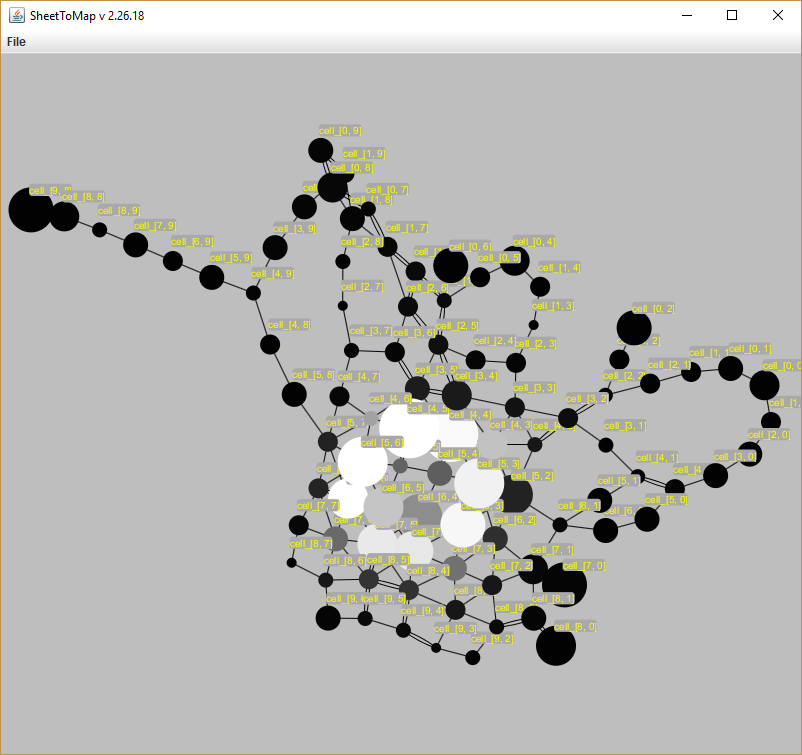
    • Anyway, pretty pix: 2018-02-26
  • Start on white paper
  • Fika

Phil 2.14.18

7:00 – 4:00 ASRC

  • Stampede? Herding? Twitter deleted 200,000 Russian troll tweets. Read them here.
    • Twitter doesn’t make it easy to track Russian propaganda efforts — this database can help
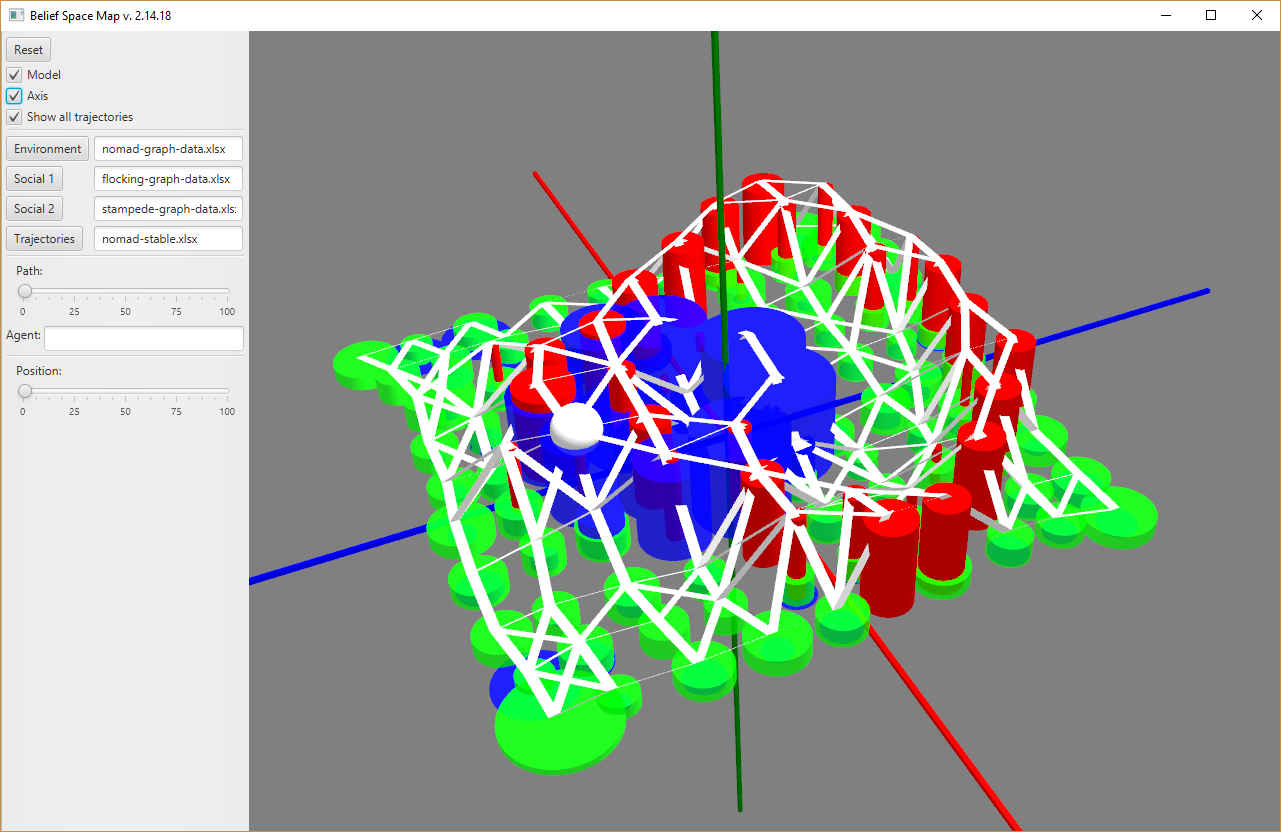
  • Add a “show all trajectories” checkbox.
    • That’s a nice visualization that shows the idea of the terrain uncovered by the trajectories: 2018-02-14
  • Continue with paper – down to 3 pages!
  • Continue with slides. Initial walkthrough with Aaron
  • 3:00 – 4:00 A2P meeting

Phil 2.13.18

7:00 – 4:00 ASRC MKT

  • UMAP: Uniform Manifold Approximation and Projection for Dimension Reduction
    • UMAP (Uniform Manifold Approximation and Projection) is a novel manifold learning technique for dimension reduction. UMAP is constructed from a theoretical framework based in Riemannian geometry and algebraic topology. The result is a practical scalable algorithm that applies to real world data. The UMAP algorithm is competitive with t-SNE for visualization quality, and arguably preserves more of the global structure with superior run time performance. Furthermore, UMAP as described has no computational restrictions on embedding dimension, making it viable as a general purpose dimension reduction technique for machine learning.
  • How Prevalent are Filter Bubbles and Echo Chambers on Social Media? Not as Much as Conventional Wisdom Has It
    • Yet, as Rasmus points out, conventional wisdom seems to be stuck with the idea that social media constitute filter bubbles and echo chambers, where most people only, or mostly, see political content they already agree with. It is definitely true that there is a lot of easily accessible, clearly identifiable, highly partisan content on social media. It is also true that, to some extent, social media users can make choices as to which sources they follow and engage with. Whether people use these choice affordances solely to flock to content reinforcing their political preferences and prejudices, filtering out or avoiding content that espouses other viewpoints, is, however, an empirical question—not a destiny inscribed in the way social media and their algorithms function.
  • He Predicted The 2016 Fake News Crisis. Now He’s Worried About An Information Apocalypse.
    • That future, according to Ovadya, will arrive with a slew of slick, easy-to-use, and eventually seamless technological tools for manipulating perception and falsifying reality, for which terms have already been coined — “reality apathy,” “automated laser phishing,” and “human puppets.”
  • Finish first pass at DC slides – done!
  • Begin trimming paper – good progress.
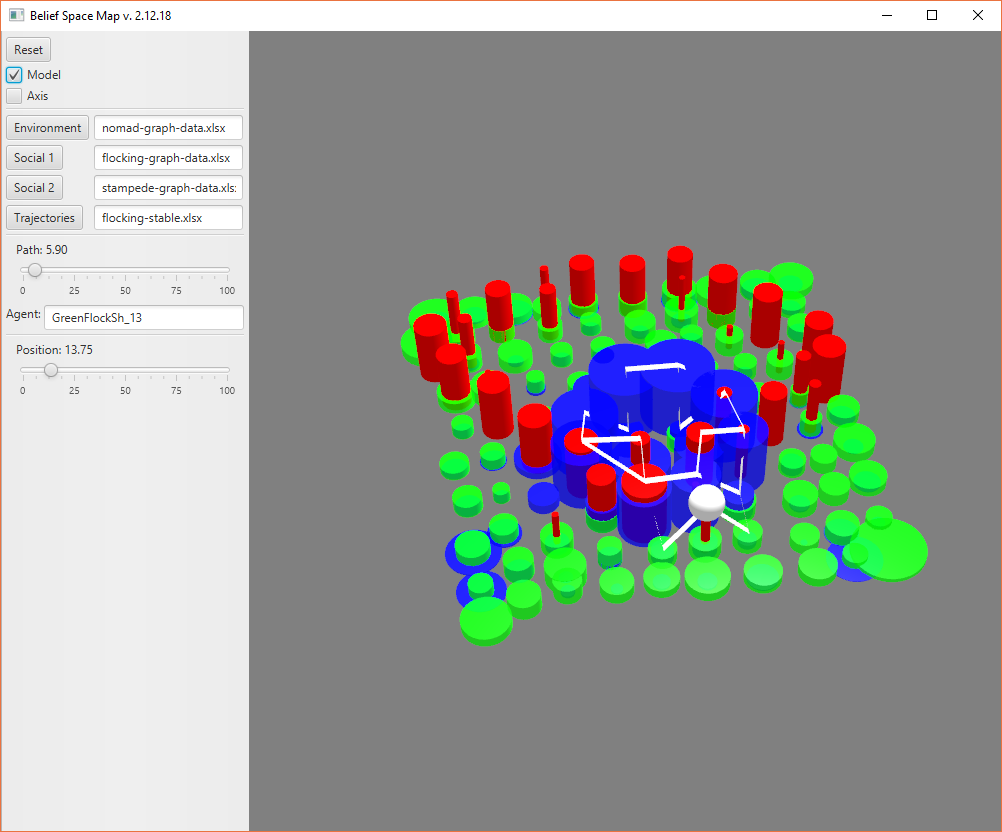
  • Add a slider that lets the user interactively move a token along the selected trajectory path – done. Yes, it looks like a golf ball on a tee… Capture
  • Sprint planning

Phil 2.12.18

7:00 – 4:00 ASRC MKT

  • The social structural foundations of adaptation and transformation in social–ecological systems
    • Social networks are frequently cited as vital for facilitating successful adaptation and transformation in linked social–ecological systems to overcome pressing resource management challenges. Yet confusion remains over the precise nature of adaptation vs. transformation and the specific social network structures that facilitate these processes. Here, we adopt a network perspective to theorize a continuum of structural capacities in social–ecological systems that set the stage for effective adaptation and transformation. We begin by drawing on the resilience literature and the multilayered action situation to link processes of change in social–ecological systems to decision making across multiple layers of rules underpinning societal organization. We then present a framework that hypothesizes seven specific social–ecological network configurations that lay the structural foundation necessary for facilitating adaptation and transformation, given the type and magnitude of human action required. A key contribution of the framework is explicit consideration of how social networks relate to ecological structures and the particular environmental problem at hand. Of the seven configurations identified, three are linked to capacities conducive to adaptation and three to transformation, and one is hypothesized to be important for facilitating both processes.
  • Starting to trim paper down to three pages
  • Starting on CHIIR slide stack – Still need to add future work
  • Springt Review
  • Rwanda radio transcripts
    • From October 1993 to late 1994, RTLM was used by Hutu leaders to advance an extremist Hutu message and anti-Tutsi disinformation, spreading fear of a Tutsi genocide against Hutu, identifying specific Tutsi targets or areas where they could be found, and encouraging the progress of the genocide. In April 1994, Radio Rwanda began to advance a similar message, speaking for the national authorities, issuing directives on how and where to kill Tutsis, and congratulating those who had already taken part.
  • Fika
    • Set up Fika Writing group that will meet Wednesdays at 4:00. We’ll see how that goes.

2.9.18

7:00 – 5:00 ASRC MKT

  • Add something about a population of ants – done
  • Add loaders for the three populations, and then one for trajectories
    • Promoted WeightWidget to JavaUtils
    • Moving 3d and UI building out of start
    • Ugh, new IntelliJ
    • Made the graph pieces selectable
    • Got drawmode (LINE) working
    • Reading in trajectories
    • Need to load each as a child and then draw all of them first, then make that selectable. Done!
  • Go over draft with Aaron. Hand off for rewrite 1? Nope – family emergency
  • 2:00 meeting with Aaron and IC team? Nope
  • Intro to deep learning course from MIT: introtodeeplearning.com
    • An introductory course on deep learning methods with applications to machine translation, image recognition, game playing, image generation and more. A collaborative course incorporating labs in TensorFlow and peer brainstorming along with lectures. Course concludes with project proposals with feedback from staff and panel of industry sponsors.
  • Topics, Events, Stories in Social Media
    • This thesis focuses on developing methods for social media analysis. Specifically, five directions are proposed here: 1) semi-supervised detection for targeted-domain events, 2) topical interaction study among multiple datasets, 3) discriminative learning about the identifications for common and distinctive topics, 4) epidemics modeling for flu forecasting with simulation via signals from social media data, 5) storyline generation for massive unorganized documents.
  • Communication by virus
    • The standard way to think about neurons is somewhat passive. Yes, they can exciteor inhibit the neurons they communicate with but, at the end of the day, they are passively relaying whatever information they contain. This is true not only in biologicalneurons but also in artificial neural networks. 

Phil 2.7/18

7:30 – 5:30 ASRC MKT

  • Freezing rain and general ick, so I’m working from home. Thus leading to the inevitable updating of IntelliJ
  • Working on the 3D mapping app.
    • Reading in single spreadsheet with nomad graph info
    • Building a NodeInfo inner class to keep the nomad positions for the other populations
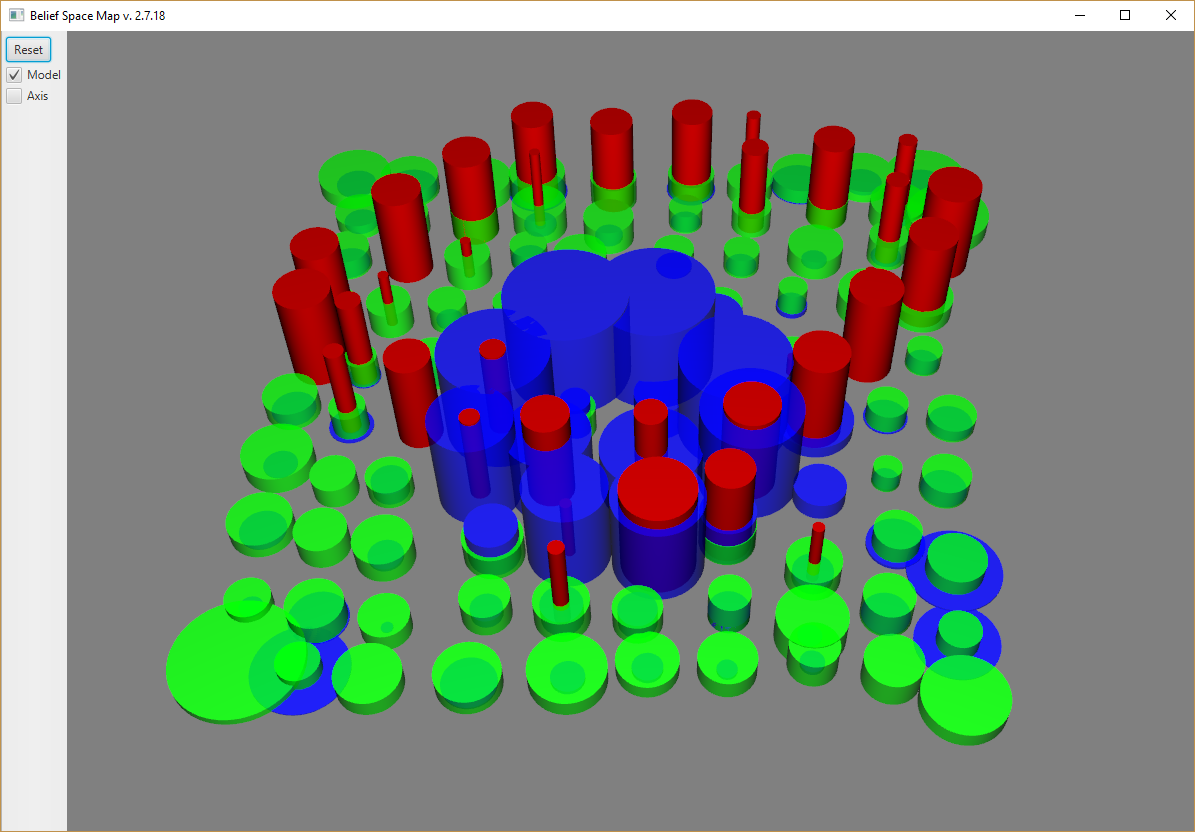
    • Working! 2018-02-07
    • Better: 2018-02-07 (2)
    • Resisting the urge to code more and getting back to the extended abstract. I also need to add a legend to the above pix.
  • Back to extended abstract
    • Added results and future work section
    • got all the pictures in
    • Currently at 3 pages plus. Not horrible.
  • Demographics and Dynamics of Mechanical Turk Workers
    • There are about 100K-200K unique workers on Amazon. On average, there are 2K-5K workers active on Amazon at any given time, which is equivalent to having 10K-25K full-time employees. On average, 50% of the worker population changes within 12-18 months. Workers exhibit widely different patterns of activity, with most workers being active only occasionally, and few workers being very active. Combining our results with the results from Hara et al, we see that MTurk has a yearly transaction volume of a few hundreds of millions of dollars.

Phil 1.9.18

7:00 – 4:00 ASRC MKT

  • Submit DC paper – done
  • Add primary goal and secondary goals
  • Add group decision making tool to secondary goals
  • Add site search to “standard” websearch – done
  • Visual Analytics to Support Evidence-Based Decision Making (dissertation)
  • Can Public Diplomacy Survive the internet? Bots, Echo chambers, and Disinformation
    • Shawn Powers serves as the Executive Director of the United States Advisory Commission on Public Diplomacy
    • Markos Kounalakis, Ph.D. is a visiting fellow at the Hoover Institution at Stanford University and is a presidentially appointed member of the J. William Fulbright Foreign Scholarship Board.  Kounalakis is a senior fellow at the Center for Media, Data and Society at Central European University in Budapest, Hungary and president and publisher emeritus of the Washington Monthly. He is currently researching a book on the geopolitics of global news networks.
  • Partisanship, Propaganda, and Disinformation: Online Media and the 2016 U.S. Presidential Election (Harvard)
    • Rob Faris
    • Hal Roberts
    • Bruce Etling
    • Nikki Bourassa 
    • Ethan Zuckerman
    • Yochai Benkler
    • We find that the structure and composition of media on the right and left are quite different. The leading media on the right and left are rooted in different traditions and journalistic practices. On the conservative side, more attention was paid to pro-Trump, highly partisan media outlets. On the liberal side, by contrast, the center of gravity was made up largely of long-standing media organizations steeped in the traditions and practices of objective journalism.

      Our data supports lines of research on polarization in American politics that focus on the asymmetric patterns between the left and the right, rather than studies that see polarization as a general historical phenomenon, driven by technology or other mechanisms that apply across the partisan divide.

      The analysis includes the evaluation and mapping of the media landscape from several perspectives and is based on large-scale data collection of media stories published on the web and shared on Twitter.

Phil 12.19.17

7:00 – 5:00 ASRC MKT

  • Trust, Identity Politics and the Media
    • Essential to a free and functioning democracy is an independent press, a crucial civil society actor that holds government to account and provides citizens access to the impartial information they need to make informed judgments, reason together, exercise their rights and responsibilities, and engage in collective action. In times of crisis, the media fulfills the vital role of alerting the public to danger and connecting citizens to rescue efforts, as Ushahidi has done in Kenya. Or, it can alert the international community to human rights abuses as does Raqqa is Being Slaughtered Silently. But, the very capabilities that allow the media to alert and inform, also allow it to sow division – as it did in Rwanda leading up to and during the genocide– by spreading untruths, and, through “dog whistles,” targeting ethnic groups and inciting violence against them. This panel will focus on two topics: the role of media as a vehicle for advancing or undermining social cohesion, and the use of media to innovate, organize and deepen understanding, enabling positive collective action.
      • Abdalaziz Alhamza, Co-Founder, Raqqa is Being Slaughtered Silently
      • Uzodinma Iweala, CEO and Editor-in-Chief, Ventures Africa; Author, Beasts of No Nation; Producer, Waiting for Hassana (moderator)
      • Ben Rattray, Founder and CEO, Change.org
      • Malika Saada Saar, Senior Counsel on Civil and Human Rights, Google
  • Continuing Consensus and Cooperation in Networked Multi-Agent Systems here Done! Promoted to phlog.
  • An Agent-Based Model of Indirect Minority Influence on Social Change and Diversity
    • The present paper describes an agent-based model of indirect minority influence. It examines whether indirect minority influence can lead to social change as a function of cognitive rebalancing, a process whereby related attitudes are affected when one attitude is changed. An attitude updating algorithm was modelled with minimal assumptions drawing on social psychology theories of indirect minority influence. Results revealed that facing direct majority influence, indirect minority influence along with cognitive rebalancing is a recipe for social change. Furthermore, indirect minority influence promotes and maintains attitudinal diversity in local ingroups and throughout the society. We discuss the findings in terms of social influence theories and suggest promising avenues for model extensions for theory building in minority influence and social change.
  • Ok, time to switch gears and start on the flocking paper. And speaking of which, is this a venue?
    • Winter Simulation Conference 2017 – INFORMS Meetings Browser times out right now, so is it still valid?
    • Created a new LaTex project, since this is a modification of the CHIIR paper and started to slot pieces in. It is *hard* switching gears. Leaving it in the sigchi format for now.
    • I went to change out the echo chamber distance from average with heading from average (which looks way better), but everything was zero in the spreadsheet. After poking around a bit, I was “fixing” the angle cosine to lie on (-1, 1), by forcing it to be 1.0 all the time. Fixed. EchoChamberAngle
  • Sprint planning. I’m on the hook for writing up the mapping white paper and strawman design

Phil 12/15/17

9:00 – 1:30 ASRC MKT

  • Looong day yesterday
  • Sprint review
  • This looks like an interesting alternative to blockchain for document security: A Cryptocurrency Without a Blockchain Has Been Built to Outperform Bitcoin
    • The controversial currency IOTA rests on a mathematical “tangle” that its creators say will make it much faster and more efficient to run.
  • Also this: Can AI Win the War Against Fake News?
    • Developers are working on tools that can help spot suspect stories and call them out, but it may be the beginning of an automated arms race. 
    • Mentions adverifai.com
      • FakeRank is like PageRank for Fake News detection, only that instead of links between web pages, the network consists of facts and supporting evidence. It leverages knowledge from the Web with Deep Learning and Natural Language Processing techniques to understand the meaning of a news story and verify that it is supported by facts.

Phil 12.14.17

7:00 – 11:00 ASRC MKT

Phil 12.13.17

7:00 – 5:00 ASRC MKT

  • Schedule physical
  • Write up fire stampede. Done!
  • Continuing Consensus and Cooperation in Networked Multi-Agent Systems here
  • Would like to see how the credibility cues on the document were presented. What went right and what went wrong: Schumer calls cops after forged sex scandal charge
  • Finished linking the RB components to the use cases. Waiting on Aaron to finish SIGINT use case
  • Working on building maps from trajectories. Trying http://graphstream-project.org
    • Updating Labeled2DMatrix to read in string values. I had never finished that part! There are some issues with what to do about column headers. I think I’m going to add explicit headers for the ‘Trajectory’ sheet
  • Strategized with Aaron about how to approach the event tomorrow. And Deep Neural Network Capsules. And Social Gradient Descent Agents.
    • deep neural nets learn by back-propagation of errors over the entire network. In contrast real brains supposedly wire neurons by Hebbian principles: “units that fire together, wire together”. Capsules mimic Hebbian learning in the way that: “A lower-level capsule prefers to send its output to higher level capsules whose activity vectors have a big scalar product with the prediction coming from the lower-level capsule”
      • Sure sounds like oscillator frequency locking / flocking to me……

Phil 12.12.17

7:00 – 3:30 ASRC MKT

  • Need to make sure that an amplified agent also has amplified influence in calculating velocity – Fixed
  • Towards the end of this video is an interview with Ian Couzin talking about how mass communication is disrupting our ability to flock ‘correctly’ due to the decoupling of distance and information
  • Write up fire stampede. Backups everywhere, one hole, antennas burn so the AI keeps trust in A* but loses awareness as the antennas burn: “The Los Angeles Police Department asked drivers to avoid navigation apps, which are steering users onto more open routes — in this case, streets in the neighborhoods that are on fire.” [LA Times] Also this slow motion version of the same thing: For the Good of Society — and Traffic! — Delete Your Map App
  • First self-driving car ‘race’ ends in a crash at the Buenos Aires Formula E ePrix; two cars enter, one car survives
  • Taking a closer look at Oscillator Models and Collective Motion (178 Citations) and Consensus and Cooperation in Networked Multi-Agent Systems (6,291 Citations)
  • Consensus and Cooperation in Networked Multi-Agent Systems
    • Reza Olfati-SaberAlex Fax, and Richard M. Murray
    • We discuss the connections between consensus problems in networked dynamic systems and diverse applications including synchronization of coupled oscillators, flocking, formation control, fast consensus in small world networks, Markov processes and gossip-based algorithms, load balancing in networks, rendezvous in space, distributed sensor fusion in sensor networks, and belief propagation. We establish direct connections between spectral and structural properties of complex networks and the speed of information diffusion of consensus algorithms (Abstract)
    • In networks of agents (or dynamic systems), “consensus” means to reach an agreement regarding a certain quantity of interest that depends on the state of all agents. A “consensus algorithm” (or protocol) is an interaction rule that specifies the information exchange between an agent and all of its (nearest) neighbors on the network (pp 215)
      • In my work, this is agreement on heading and velocity
    • Graph Laplacians are an important point of focus of this paper. It is worth mentioning that the second smallest eigenvalue of graph Laplacians called algebraic connectivity quantifies the speed of convergence of consensus algorithms. (pp 216)
    • More recently, there has been a tremendous surge of interest among researchers from various disciplines of engineering and science in problems related to multi-agent networked systems with close ties to consensus problems. This includes subjects such as consensus [26]–[32], collective behavior of flocks and swarms [19], [33]–[37], sensor fusion [38]–[40], random networks [41], [42], synchronization of coupled oscillators [42]–[46], algebraic connectivity of complex networks [47]–[49], asynchronous distributed algorithms [30], [50], formation control for multi-robot systems [51]–[59], optimization-based cooperative control [60]–[63], dynamic graphs [64]–[67], complexity of coordinated tasks [68]–[71], and consensus-based belief propagation in Bayesian networks [72], [73]. (pp 216)
      • That is a dense lit review. How did they order it thematically?
    • A byproduct of this framework is to demonstrate that seemingly different consensus algorithms in the literature [10], [12]–[15] are closely related. (pp 216)
    • To understand the role of cooperation in performing coordinated tasks, we need to distinguish between unconstrained and constrained consensus problems. An unconstrained consensus problem is simply the alignment problem in which it suffices that the state of all agents asymptotically be the same. In contrast, in distributed computation of a function f(z), the state of all agents has to asymptotically become equal to f(z), meaning that the consensus problem is constrained. We refer to this constrained consensus problem as the f-consensus problem. (pp 217)
      • Normal exploring/flocking/stampeding is unconstrained. Herding adds constraint, though it’s dynamic. The variables that have to be manipulated in the case of constraint to result in the same amount of consensus are probably what’s interesting here. Examples could be how ‘loud’ does the herder have to be? Also, how ‘primed’ does the population have to be to accept herding?
    • …cooperation can be informally interpreted as “giving consent to providing one’s state and following a common protocol that serves the group objective.” (pp 217)
    • Formal analysis of the behavior of systems that involve more than one type of agent is more complicated, particularly, in presence of adversarial agents in noncooperative games [79], [80]. (pp 217)
    • The reason matrix theory [81] is so widely used in analysis of consensus algorithms [10], [12], [13], [14], [15], [64] is primarily due to the structure of P in (4) and its connection to graphs. (pp 218)
    • The role of consensus algorithms in particle based flocking is for an agent to achieve velocity matching with respect to its neighbors. In [19], it is demonstrated that flocks are networks of dynamic systems with a dynamic topology. This topology is a proximity graph that depends on the state of all agents and is determined locally for each agent, i.e., the topology of flocks is a state dependent graph. The notion of state-dependent graphs was introduced by Mesbahi [64] in a context that is independent of flocking. (pp 218)
      • They leave out heading alignment here. Deliberate? Or is heading alignment just another variant on velocity
    • Consider a network of decision-making agents with dynamics ẋi = ui interested in reaching a consensus via local communication with their neighbors on a graph G = (V, E). By reaching a consensus, we mean asymptotically converging to a one-dimensional agreement space characterized by the following equation: x1 = x2 = … = x (pp 219)
    • A dynamic graph G(t) = (V, E(t)) is a graph in which the set of edges E(t) and the adjacency matrix A(t) are time-varying. Clearly, the set of neighbors Ni(t) of every agent in a dynamic graph is a time-varying set as well. Dynamic graphs are useful for describing the network topology of mobile sensor networks and flocks [19]. (pp 219)
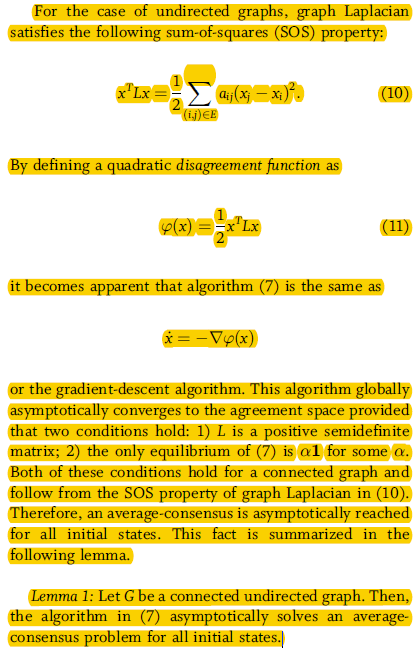
    • GraphLaplacianGradientDescent(pp 220)
  • algebraic connectivity of a graph: The algebraic connectivity (also known as Fiedler value or Fiedler eigenvalue) of a graph G is the second-smallest eigenvalue of the Laplacian matrix of G.[1] This eigenvalue is greater than 0 if and only if G is a connected graph. This is a corollary to the fact that the number of times 0 appears as an eigenvalue in the Laplacian is the number of connected components in the graph. The magnitude of this value reflects how well connected the overall graph is. It has been used in analysing the robustness and synchronizability of networks. (wikipedia) (pp 220)
  • According to Gershgorin theorem [81], all eigenvalues of L in the complex plane are located in a closed disk centered at delta + 0j with a radius of delta, the maximum degree of a graph (pp 220)
    • This is another measure that I can do of the nomad/flock/stampede structures combined with DBSCAN. Each agent knows what agents it is connected with, and we know how many agents there are. Each agent row should just have the number of agents it is connected to.
  • In many scenarios, networked systems can possess a dynamic topology that is time-varying due to node and link failures/creations, packet-loss [40], [98], asynchronous consensus [41], state-dependence [64], formation reconfiguration [53], evolution [96], and flocking [19], [99]. Networked systems with a dynamic topology are commonly known as switching networks. (pp 226)
  • Conclusion: A theoretical framework was provided for analysis of consensus algorithms for networked multi-agent systems with fixed or dynamic topology and directed information flow. The connections between consensus problems and several applications were discussed that include synchronization of coupled oscillators, flocking, formation control, fast consensus in small-world networks, Markov processes and gossip-based algorithms, load balancing in networks, rendezvous in space, distributed sensor fusion in sensor networks, and belief propagation. The role of “cooperation” in distributed coordination of networked autonomous systems was clarified and the effects of lack of cooperation was demonstrated by an example. It was demonstrated that notions such as graph Laplacians, nonnegative stochasticmatrices, and algebraic connectivity of graphs and digraphs play an instrumental role in analysis of consensus algorithms. We proved that algorithms introduced by Jadbabaie et al. and Fax and Murray are identical for graphs with n self-loops and are both special cases of the consensus algorithm of Olfati-Saber and Murray. The notion of Perron matrices was introduced as the discrete-time counterpart of graph Laplacians in consensus protocols. A number of fundamental spectral properties of Perron matrices were proved. This led to a unified framework for expression and analysis of consensus algorithms in both continuous-time and discrete-time. Simulation results for reaching a consensus in small-worlds versus lattice-type nearest-neighbor graphs and cooperative control of multivehicle formations were presented. (pp 231)
  • Not sure about this one. It just may be another set of algorithms to do flocking. Maybe some network implications? Flocking for Multi-Agent Dynamic Systems: Algorithms and Theory. It is one of the papers that the Consensus and Cooperation paper above leans on heavily though…
  • The Emergence of Consensus: A Primer
    • The origin of population-scale coordination has puzzled philosophers and scientists for centuries. Recently, game theory, evolutionary approaches and complex systems science have provided quantitative insights on the mechanisms of social consensus. However, the literature is vast and scattered widely across fields, making it hard for the single researcher to navigate it. This short review aims to provide a compact overview of the main dimensions over which the debate has unfolded and to discuss some representative examples. It focuses on those situations in which consensus emerges ‘spontaneously’ in absence of centralised institutions and covers topic that include the macroscopic consequences of the different microscopic rules of behavioural contagion, the role of social networks, and the mechanisms that prevent the formation of a consensus or alter it after it has emerged. Special attention is devoted to the recent wave of experiments on the emergence of consensus in social systems.
  • Critical dynamics in population vaccinating behavior
    • Complex adaptive systems exhibit characteristic dynamics near tipping points such as critical slowing down (declining resilience to perturbations). We studied Twitter and Google search data about measles from California and the United States before and after the 2014–2015 Disneyland, California measles outbreak. We find critical slowing down starting a few years before the outbreak. However, population response to the outbreak causes resilience to increase afterward. A mathematical model of measles transmission and population vaccine sentiment predicts the same patterns. Crucially, critical slowing down begins long before a system actually reaches a tipping point. Thus, it may be possible to develop analytical tools to detect populations at heightened risk of a future episode of widespread vaccine refusal.
  • For Aaron’s Social Gradient Descent Agent research (lit review)
    • On distributed search in an uncertain environment (Something like Social Gradient Descent Agents)
      • The paper investigates the case where N agents solve a complex search problem by communicating to each other their relative successes in solving the task. The problem consists in identifying a set of unknown points distributed in an n–dimensional space. The interaction rule causes the agents to organize themselves so that, asymptotically, each agent converges to a different point. The emphasis of this paper is on analyzing the collective dynamics resulting from nonlinear interactions and, in particular, to prove convergence of the search process.
    • A New Clustering Algorithm Based Upon Flocking On Complex Network (Sizing and timing for flocking systems seems to be ok?)
      • We have proposed a model based upon flocking on a complex network, and then developed two clustering algorithms on the basis of it. In the algorithms, firstly a k-nearest neighbor (knn) graph as a weighted and directed graph is produced among all data points in a dataset each of which is regarded as an agent who can move in space, and then a time-varying complex network is created by adding long-range links for each data point. Furthermore, each data point is not only acted by its k nearest neighbors but also r long-range neighbors through fields established in space by them together, so it will take a step along the direction of the vector sum of all fields. It is more important that these long-range links provides some hidden information for each data point when it moves and at the same time accelerate its speed converging to a center. As they move in space according to the proposed model, data points that belong to the same class are located at a same position gradually, whereas those that belong to different classes are away from one another. Consequently, the experimental results have demonstrated that data points in datasets are clustered reasonably and efficiently, and the rates of convergence of clustering algorithms are fast enough. Moreover, the comparison with other algorithms also provides an indication of the effectiveness of the proposed approach.
  • Done with the first draft of the white paper! And added the RFP section to the LMN productization version
  • Amazon Sage​Maker: Amazon SageMaker is a fully managed machine learning service. With Amazon SageMaker, data scientists and developers can quickly and easily build and train machine learning models, and then directly deploy them into a production-ready hosted environment. It provides an integrated Jupyter authoring notebook instance for easy access to your data sources for exploration and analysis, so you don’t have to manage servers. It also provides common machine learning algorithms that are optimized to run efficiently against extremely large data in a distributed environment. With native support for bring-your-own-algorithms and frameworks, Amazon SageMaker offers flexible distributed training options that adjust to your specific workflows. Deploy a model into a secure and scalable environment by launching it with a single click from the Amazon SageMaker console. Training and hosting are billed by minutes of usage, with no minimum fees and no upfront commitments. (from the documentation)

4:00 – 5:00 Meeting with Aaron M. to discuss Academic RB wishlist.

Phil 11.17.17

7:00 – ASRC MKT

  • Reuters Tracer: Toward Automated News Production Using Large Scale Social Media Data
    • To deal with the sheer volume of information and gain competitive advantage, the news industry has started to explore and invest in news automation. In this paper, we present Reuters Tracer, a system that automates end-to-end news production using Twitter data. It is capable of detecting, classifying, annotating, and disseminating news in real time for Reuters journalists without manual intervention. In contrast to other similar systems, Tracer is topic and domain agnostic. It has a bottom-up approach to news detection, and does not rely on a predefined set of sources or subjects. Instead, it identifies emerging conversations from 12+ million tweets per day and selects those that are news-like. Then, it contextualizes each story by adding a summary and a topic to it, estimating its newsworthiness, veracity, novelty, and scope, and geotags it. Designing algorithms to generate news that meets the standards of Reuters journalists in accuracy and timeliness is quite challenging. But Tracer is able to achieve competitive precision, recall, timeliness, and veracity on news detection and delivery. In this paper, we reveal our key algorithm designs and evaluations that helped us achieve this goal, and lessons learned along the way.
  • Maybe the adjacency matrix that we think we can produce from the trajectories can be used as the basis for a self-organizing map?
  • Gobo: TL;DR: This is a MIT research project to study how people filter their social media feeds. We are tracking your use of the site, but will only publish it anonymously and in aggregate. We might follow up with you to hear more about what you think about Gobo. The MIT Institutional Review Board has approved of this study. Gobo
  • This, plus , makes me think that MIT may be starting to focus on these issues.
  • Back to The Group Polarization Phenomenon
    •  David G. Myers
    • Pictures may be important as part of an argument. Need to be able to support that.
    • This polarization concept should also be distinguished from a related concept, extremization. Whereas polarization refers to shifts toward the already preferred pole, extremization has been used to refer to movement away from neutrality, regardless of direction. Since all instances of group polarization are instances of extremization, but not vice versa, extremization may be easier to demonstrate than polarization. (pp 603)
    • For convenience we have organized these studies into seven categories: attitudes, jury decisions, ethical decisions, judgments, person perceptions, negotiation behavior, and risk measures other than the choice dilemmas. This categorization is admittedly somewhat arbitrary. (pp 604)
    • In other studies, however, it is possible to infer the direction of initial preferences. Robinson (1941) conducted lengthy discussions of two attitudes. On attitude toward war, where students were initially quite pacifistic, there was a nonsignificant shift to even more pacifism following discussion. On attitude toward capital punishment, to which students were initially opposed, there was a significant shift to even stronger opposition. (pp 604)
    • Varying the stimulus materials. Myers and Kaplan (1976) engaged their subjects in discussion of stimulus materials which elicited a dominant predisposition of guilty or not guilty. After discussing traffic cases in which the defendants were made to appear as low in guilt, the Subjects Were even more definite in their judgments of innocence and more lenient in recommended punishment. After discussing “high-guilt” cases, the subjects polarized toward harsher judgments of guilt and punishment. (pp 605)
    • Group composition studies. Vidmar composed groups of jurors high or low in dogmatism. The high-dogmatism juries shifted toward harsher sentences following discussion, and the low-dogmatism groups shifted toward more lenient sentences, despite the fact that the high- and low-dogmatism juries did not differ in their predeliberation judgments. (pp 606)
    • Main and Walker (1973) observed that these constitutionality decisions were also more libertarian in the group condition (65% versus 45%). Although a minority of the single-judge decisions were prolibertarian, Walker and Main surmised that the preexisting private values of the judges were actually prolibertarian and that their decisions made alone were compromised in the face of antilibertarian public pressure. Their private values were then supposedly released and reinforced in the professional group context (pp 606)
    • From what we have been able to perceive thus far, the process is an interesting combination of rational persuasion, sheer social pressure, and the psychological mechanism by which individual perceptions undergo change when exposed to group discussion (pp 606)
    • Myers (1975) also used a faculty evaluation task. The subjects responded to 200 word descriptions of “good” or “bad” faculty with a scale judgment and by distributing a pay increase budget among the hypothetical faculty. As predicted by the group polarization hypothesis, good faculty were rated and paid even more favorably after the group interaction, and contrariwise for the bad faculty. (pp 608)
    • in general, the work on person perception supports the group polarization hypothesis, especially when the stimulus materials are more complex than just a single adjective. (pp 608)
    • Myers and Bach (1976) compared the conflict behavior of individuals and groups, using an expanded prisoner’s dilemma matrix cast in the language of a gas war. There was no difference in their conflict behavior (both individuals and groups were highly noncooperative). But on postexperimental scales assessing the subjects’ evaluations of themselves and their opponents, individuals tended to justify their own behavior, and groups were even more inclined toward self-justification. This demonstration of group polarization supports Janis’s (1972) contention that in situations of intergroup conflict, group members are likely to develop a strengthened belief in the inherent morality of their actions.  (pp 608)
    • Skewness cannot account for group polarization. This is particularly relevant to the majority rule scheme, which depends on a skewed distribution of initial choices. On choice dilemmas, positively skewed distributions (i.e., with a risky majority) should produce risky shift, and negatively skewed distributions should yield a conservative shift. Several findings refute this prediction. (pp 612)
    • Shifts in the group median, although slightly attenuated, are not significantly smaller than shifts in the group mean (pp 612)
    • Group shift has also been shown to occur in dyads (although somewhat reduced), where obviously there can be no skewness in the initial responses (pp 612)
    • while group decision models may be useful in other situations in which discussion is minimal or absent and the task is to reach agreement (e.g., Lambert, 1969), the models (or at least the majority rule model stressed in this analysis) are not a sufficient explanation of the group polarization findings we are seeking to explain. There are still a variety of other decision schemes that can be explored and with other specific tasks. But clearly, group induced shift on choice dilemmas is something more than a statistical artifact. (pp 612)
    • Interpersonal Comparisons theory suggests that a subject changes when he discovers that others share his inclinations more than he would have supposed, either because the group norm is discovered to be more in the preferred direction than previously imagined or because the subject is released to more strongly act out his preference after observing someone else who models it more extremely than himself. This theory, taken by itself, suggests that relevant new information which emerges during the discussion is of no consequence. Group polarization is a source effect, not a message effect. (pp 614)
      • This is very close to the flocking theory where one agent looks at the alignment and velocity of nearby agents.
    • Differences between self, presumed other, and ideal scores. One well-known and widely substantiated assumption of the interpersonal comparisons approach is the observation from choice-dilemmas research that if, after responding, the subjects go back over the items and guess how their average peer would respond and then go back over the items a third time and indicate what response they would actually admire most, they tend to estimate the group norm as more neutral than their own initial response and their ideal as more extreme (pp 613)
    • Lamm et al. (1972) have also shown that not only do subjects indicate their ideal as more extreme than their actual response, but they also suspect that the same is true of their peers. The tendency of people to perceive themselves as more in what they consider to be the socially desirable direction than their average peer extends beyond the choice dilemmas (see Codol, Note 13). For example, most businessmen believe themselves to be more ethical than the average businessman (Baumhart, 1968), and there is evidence that people perceive their own views as less prejudiced than the norm of their community (Lenihan, Note 14). (pp 613)
    • The tendency to perceive others as “behind” oneself exists only when the self response is made prior to estimating the group norm (McCauley, Kogan, & Teger, 1971; Myers, 1974). Evidently it is after one has decided for himself that there is then a tendency to consider one’s action as relatively admirable (by perceiving the average person as less admirable than oneself). (pp 613)
    • it has been reliably demonstrated that subjects perceive other persons who have responded more extremely than themselves (in the direction of their ideal) as more socially desirable than persons who have not (Baron, Monson, & Baron, 1973; Jellison & Davis, 1973; Jellison & Riskind, 1970, 1971; Madaras & Bern, 1968). A parallel finding exists in the attitude literature (Eisinger & Mills, 1968): An extreme communicator on one’s side of an issue tends to be perceived as more sincere and competent than a moderate. (pp 614)
    • Burnstein, Vinokur, and Pichevin (1974) took an informational influence viewpoint and showed that people who adopt extreme choices are presumed to possess cogent arguments and are then presumably admired for their ability. They also demonstrated that subjects have much less confidence in others’ choices than in their own, suggesting that the tendency to perceive others as more neutral than oneself simply reflects ignorance about others’ choices (pp 614)
    • self-ideal difference scores are less affected by order of measurement than self versus perceived other differences (Myers, 1974)—suggest that the self-ideal discrepancy may be the more crucial element of a viable interpersonal comparisons approach. (pp 614)
    • One set of studies has manipulated the information about others’ responses by providing fake norms. More than a dozen separate studies all show that subjects will move toward the manipulated norm (see Myers, 1973) (pp 615)
      • Can’t find this paper, but herding!
    • Consistent with this idea, they observed that exposure to others’ choices produced shift only when subjects then wrote arguments on the item. If knowledge of others’ choices was denied or if an opportunity to rethink the item was denied, no shift occurred. (pp 615)
    • On the other hand, it may be reasoned that in each of the studies producing minimal or nonexistent shift after exposure to others’ attitudes, the subjects were first induced to bind themselves publicly to a pretest choice and then simply exposed to others’ choices. It takes only a quick recall of some classic conformity studies (e.g., Asch, 1956) to realize that this was an excellent procedure for inhibiting response change. (pp 615)
    • Bishop and Myers (1974) have formulated mathematical models of the presumed informational influence mechanisms. These models assume that the amount of group shift will be determined by three factors: the direction of each argument (which alternative it favors), the persuasiveness of each argument, and the originality of each argument (the extent to which it is not already known by the group members before discussion). In discussion, the potency of an argument will be zero if either the rated persuasiveness is zero (it is trivial or irrelevant) or if all group members considered the argument before discussion (pp 616)
    • the simple direction of arguments is such an excellent predictor of shift (without considering persuasiveness and originality), it is not easy to demonstrate the superiority of the models over a simple analysis of argument direction as undertaken by Ebbesen and Bowers (1974). (pp 617)
      • This supports the notion that alignment and heading, as used in the model may really be sufficient to model polarizing behavior
    • A group that is fairly polarized on a particular item before discussion is presumably already in general possession of those arguments which polarize a group. A less extreme group has more to gain from the expression of partially shared persuasive arguments. (pp 617)
    • Passive receipt of arguments outside an interactive discussion context generally produces reduced shift (e.g., Bishop & Myers, 1974; Burnstein & Vinokur, 1973; St. Jean, 1970; St. Jean & Percival, 1974). Likewise, listening to a group discussion generally elicits less shift than actual participation (pp 617)
      • There may be implications here with respect to what’s being seen and read on the news having a lower influence than items that are being discussed on social media. A good questions is at what point does the reception of information feel ‘interactive’? Is clicking ‘like enough? My guess is that it is.
    • Verbal commitment could produce the increased sense of involvement and certainty that Moscovici and Zavolloni (1969) believe to be inherent in group polarization. (pp 618)
      • This reinforces the point above, but we need to know what the minimum threshold of what can be considered ‘verbal commitment’.
    • By offering arguments that tend toward the outer limits of his range of acceptability, the individual tests his ideals and also presents himself favorably to the group since, as we noted earlier, extremity in the direction of the ideal connotes knowledgeability and competence. (pp 618)
    • Diagram (pp 619) PolarazationDiagram
    • Arguments spoken in discussion more decisively favor the dominant alternative than do written arguments. The tendency for discussion arguments to be one-sided is probably not equal for all phases of a given discussion. Studies in speech-communications (see Fisher, 1974) suggest that one-sided discussion is especially likely after a choice direction has implicitly emerged and group members mutually reinforce their shared inclination. (pp 619)
      • This review is pre IRC, and views writing as non-interactive. THis may not be true any more.
    • The strength of the various vectors is expected to vary across situations. In more fact-oriented judgment tasks (group problem solving tasks being the extreme case), the cognitive determinants will likely be paramount, although people will still be motivated to demonstrate their abilities. On matters of social preference, in which the social desirability of actions is more evident, the direct and indirect attitudinal effects of social motivation are likely to appear. The direct impact will occur in situations in which the individual has ideals that may be compromised by presumed norms but in which exposure to others’ positions informs him that his ideals are shared more strongly or widely than he would have supposed. These situations—in which expressed ideals are a step ahead of prior responses—will also tend to elicit discussion content that is biased toward the ideals. (pp 620)
    • What is the extent of small group influence on attitudes? McGuire (1969) noted, “It is clear that any impact that the mass media have on opinion is less than that produced by informal face-to-face communication of the person with his primary groups, his family, friends, co-workers, and neighbors (p. 231,).” (pp 220)
  • Back to Angular
    • Got all of the CRUD functions working and updates the subversion repo
    • Got search running. Finished tutorial!