
One of the things that could be interesting for WH/AI to do is to recognize questions and responses to llms and point out what could be hallucinations and maybe(?) point to sources so that the user can look them up?
Pinged pbump about his aquisition editor. Never hurts to try
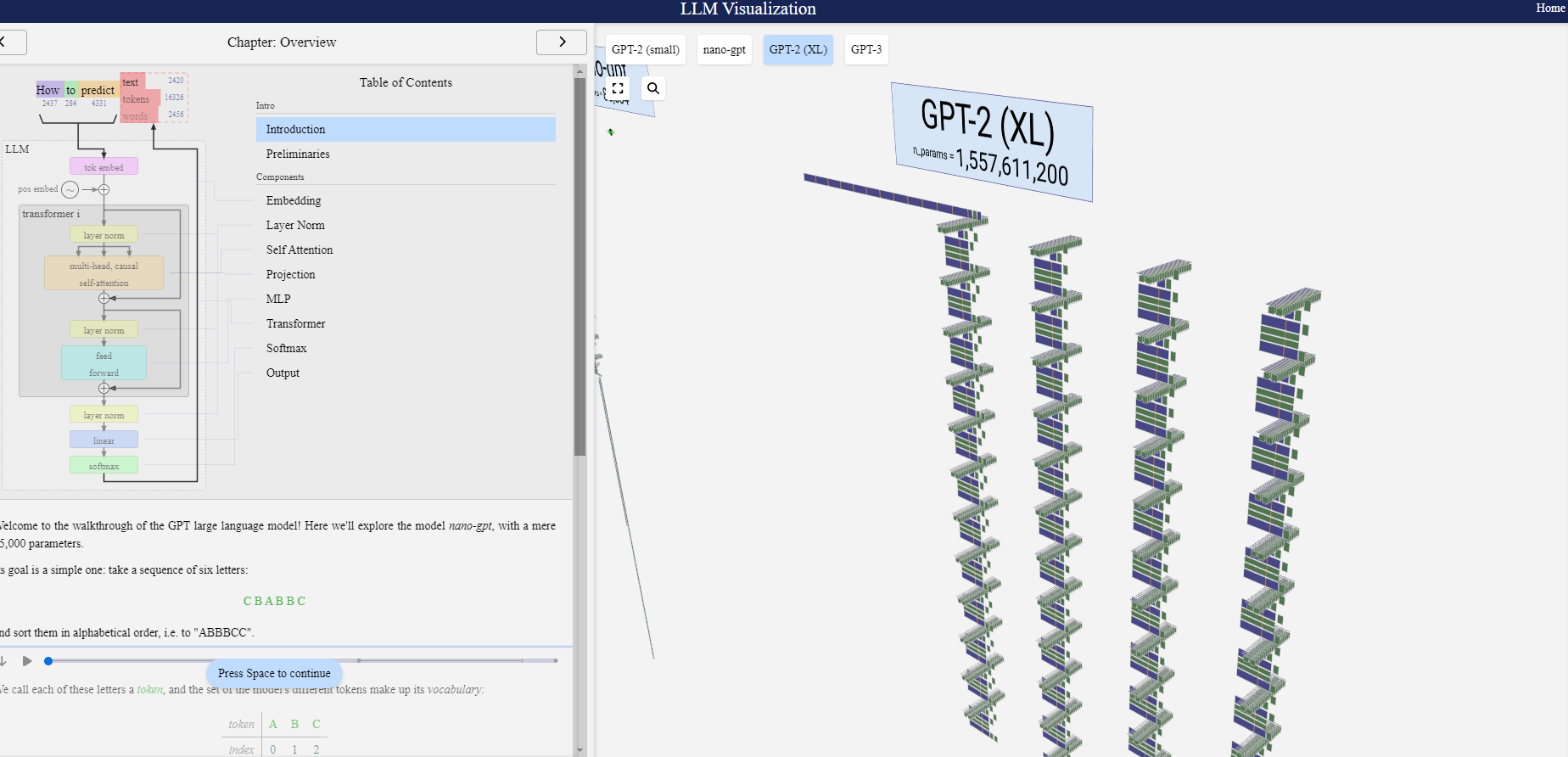
- A visualization and walkthrough of the LLM algorithm that backs OpenAI’s ChatGPT. Explore the algorithm down to every add & multiply, seeing the whole process in action.
Exploring Activation Patterns of Parameters in Language Models
- Most work treats large language models as black boxes without an in-depth understanding of their internal working mechanism. To explain the internal representations of LLMs, we utilize a gradient-based metric to assess the activation level of model parameters. Based on this metric, we obtain three preliminary findings. (1) When the inputs are in the same domain, parameters in the shallow layers will be activated densely, which means a larger portion of parameters will have great impacts on the outputs. In contrast, parameters in the deep layers are activated sparsely. (2) When the inputs are across different domains, parameters in shallow layers exhibit higher similarity in the activation behavior than in deep layers. (3) In deep layers, the similarity of the distributions of activated parameters is positively correlated to the empirical data relevance. Further, we develop three validation experiments to solidify these findings. (1) Firstly, starting from the first finding, we attempt to configure different sparsities for different layers and find this method can benefit model pruning. (2) Secondly, we find that a pruned model based on one calibration set can better handle tasks related to the calibration task than those not related, which validates the second finding. (3) Thirdly, Based on the STS-B and SICK benchmarks, we find that two sentences with consistent semantics tend to share similar parameter activation patterns in deep layers, which aligns with our third finding. Our work sheds light on the behavior of parameter activation in LLMs, and we hope these findings will have the potential to inspire more practical applications.
llamafile lets you distribute and run LLMs with a single file. (announcement blog post)
- Our goal is to make open LLMs much more accessible to both developers and end users. We’re doing that by combining llama.cpp with Cosmopolitan Libc into one framework that collapses all the complexity of LLMs down to a single-file executable (called a “llamafile”) that runs locally on most computers, with no installation.
Tasks
- Try Outlook fix – No joy, but made a bunch of screenshots and sent them off.
- Fill out LASIGE profile info – done
- Write up review for first paper – done
- First pass of Abstract for ACM opinion – done
- Delete big model from svn
- Reschedule dentist – done
SBIRS
- Write up notes from last Friday – done
- Send SOW to Dr. J and tell him that we are going to ask for a NCE – done
 viztales