Monthly Archives: December 2020

Phil 12.8.20

Chuck Yeager died today. He was born in 1923. Here’s what was flying the year he was born:

https://www.mainememory.net/artifact/23897

And here’s what is about to fly as early as tomorrow:

https://www.spacex.com/vehicles/starship/

Social cybersecurity: an emerging science

  • With the rise of online platforms where individuals could gather and spread information came the rise of online cybercrimes aimed at taking advantage of not just single individuals but collectives. In response, researchers and practitioners began trying to understand this digital playground and the way in which individuals who were socially and digitally embedded could be manipulated. What is emerging is a new scientific and engineering discipline—social cybersecurity. This paper defines this emerging area, provides case examples of the research issues and types of tools needed, and lays out a program of research in this area.
  • In today’s high tech world, beliefs opinions and attitudes are shaped as people engage with others in social media, and through the internet. Stories from creditable news sources and finding from science are challenged by actors who are actively engaged in influence operations on the internet. Lone wolfs, and large propaganda machines both disrupt civil discourse, sew discord and spread disinformation. Bots, cyborgs, trolls, sock-puppets, deep fakes, and memes are just a few of the technologies used in social engineering aimed at undermining civil society and supporting adversarial or business agendas. How can social discourse without undue influence persist in such an environment? What are the types of tools and theories needed to support such open discourse?
  • Today scientists from a large number of disciplines are working collaboratively to develop these new tools and theories. There work has led to the emergence of a new area of science—social cybersecurity. Herein, this emerging scientific area is described. Illustrative case studies are used to showcase the types of tools and theories needed. New theories and methods are also described.

MORS

  • Email to Dr. Carley – done!
  • Really nice talk by Dr. Michiel Deskevich at OptTek:
  • Information Warfare panel. Started with Gerasimov, which is pretty cool
https://viztales.com/wp-content/uploads/2020/12/image-13.png

GPT-2

  • 3:30 Meeting
    • Need to set up a meeting with Sim to tag-team together a cosine similarity for the GPT embedding.
      • I think it can be lazy, and calculate the CS as it goes.
      • Save the current distance matrix out as a csv, and read it in the next time, so that it continues to grow
      • Can use the training corpora to create a set of words as a baseline matrix
      • For words that have more than 1 embedding, have subsequent distance be specified in the matrix as “foo”, “foo1”, … “fooN”. That lets distance calculations be performed between the variants, and also to point back at the correct usage easily

Phil 12.7.20

Brrrr

5:00 Meeting with Naveen

I looked into the Association of Computational Linguistics as a possible venue for the chess paper. Aside from being a bit shorter (8 pages), the difference between the ACL papers that I looked at and an mine seems to be mostly the amount of explicit math in the description of the algorithm. Here are some examples from 2020 that I think are in roughly the same area:

Adjusting the citations to include some ACL papers (like the last one should be straightforward). The page count will have to be evaluated once the template is made public. Here’s the 2020 template: http://aacl2020.org/calls/papers/#paper-submission-and-templates

MORS

GOES

  • 3:00 Meeting with Vadim

Phil 12.4.20

UMBC now has a subscription to PolicyMap, a GIS tool that allows users to create maps, tables, and reports from a variety of datasets ranging from demographics, income, health, education, more. Maps can be created as single sheets or with multiple layers from the zip code / block level to worldwide.

Users can create individual accounts to save, share, and print work. A suite of tutorials is available to help both new and experienced users work with the tool effectively.

This is a lot of fun, and not related to anything: The Siege of Gondor, Part I: Professionals Talk Logistics

GOES

  • More Plotly

GPT Agents

Book

  • Working on Attention
  • Downloaded some seaturtle data from here: seamap.env.duke.edu
  • Changed over to storks, because I can’t find any example of a female seaturtle choosing a new beach
  • 2:00 Meeting with Michelle

Phil 12.3.20

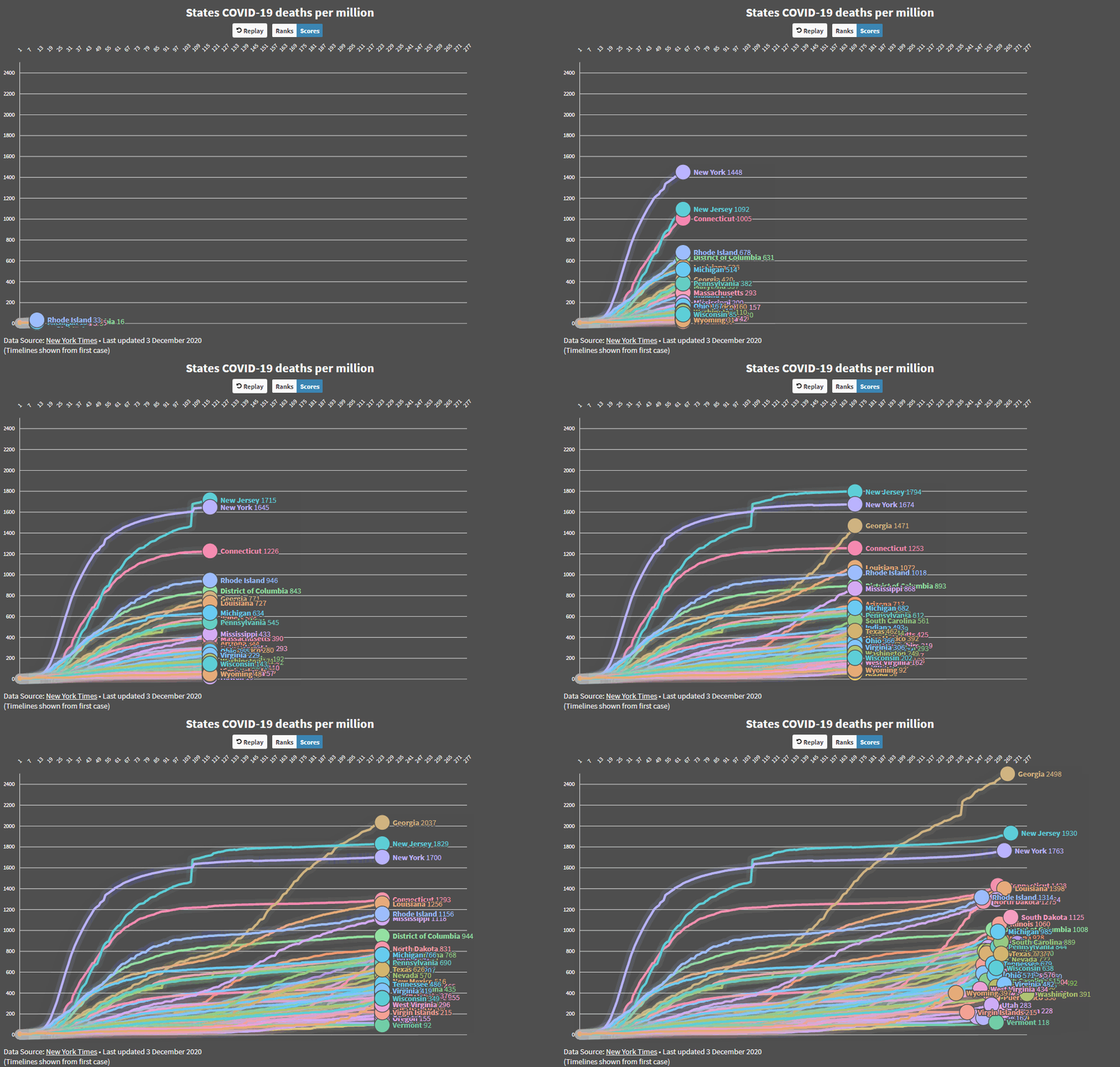
It’s been a year since we heard about COVID-19 for the first time. Let’s see how things are going. First, the selection of countries that I’ve been tracking:

https://public.flourish.studio/visualisation/4504138/

Ouch. Germany and Finland seem to be doing well in Europe, but the rest… It looks like it’s going to be a bad winter. I think it is interesting how countries like France, Italy and Switzerland that seemed to have things under control are now at USA levels of deaths per million.

Let’s see how the US is doing:

https://public.flourish.studio/visualisation/4303726/

The hard-hit eastern states still look a lot like the parts of Europe that are still on top of the spread. Georgia, Mississippi, and the Dakotas look very bad. Washington and California, which were hit early, are still experiencing very low rates. I guess we’ll see how this chart looks in January. If there is a Thanksgiving-related surge, we should see it by then.

Book

  • Work on attention

GOES

  • 10:00 Meeting with Vadim. Pymoo is much better to install than Pyomo. It’s API seems more straightforward too. Vadim is working on figuring out the examples
  • 2:00 Meeting. Just a quick status
  • Status report
  • Long chat with Aaron

GPT-2 Agents

  • The generated HTML file to make that chart is huge, btw. It’s 2.9MB.
  • And it’s slooooooow if you just use fig.show(). fig.write_html(‘file_name.html’, auto_open=True) is much faster. Ok. That means the figures can be saved as dynamic pages, which is kind of cool.
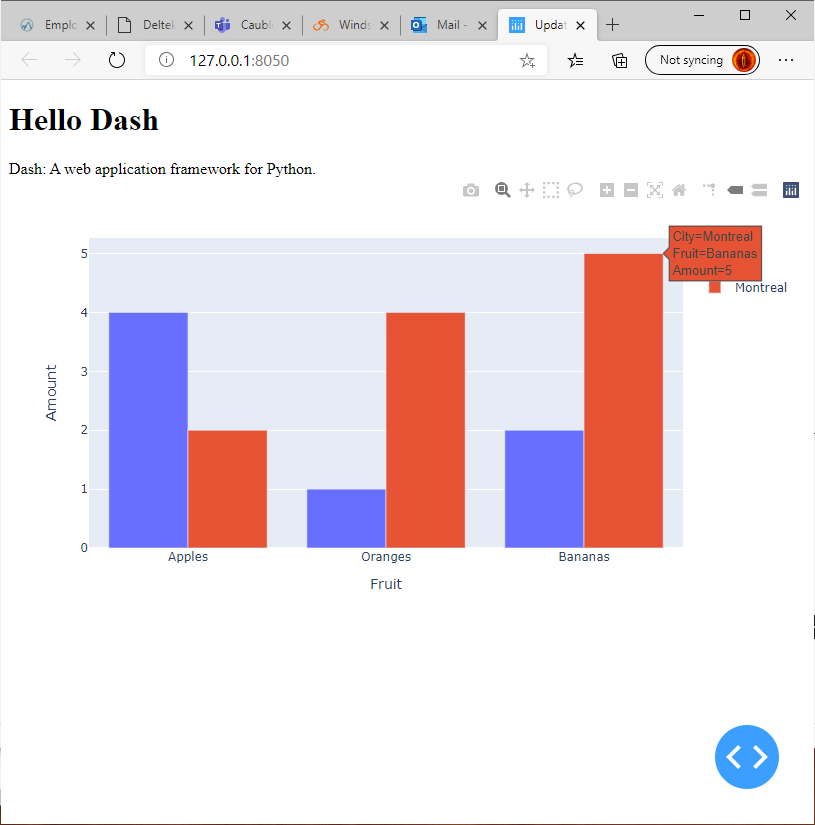
  • Got dash running, which set up a server for your interactive graphs. Not really sure which one is better, though I’m guessing that data can be live inside dash graphs. I don’t think this will matter too much with the embedding charts, but it’s good to know
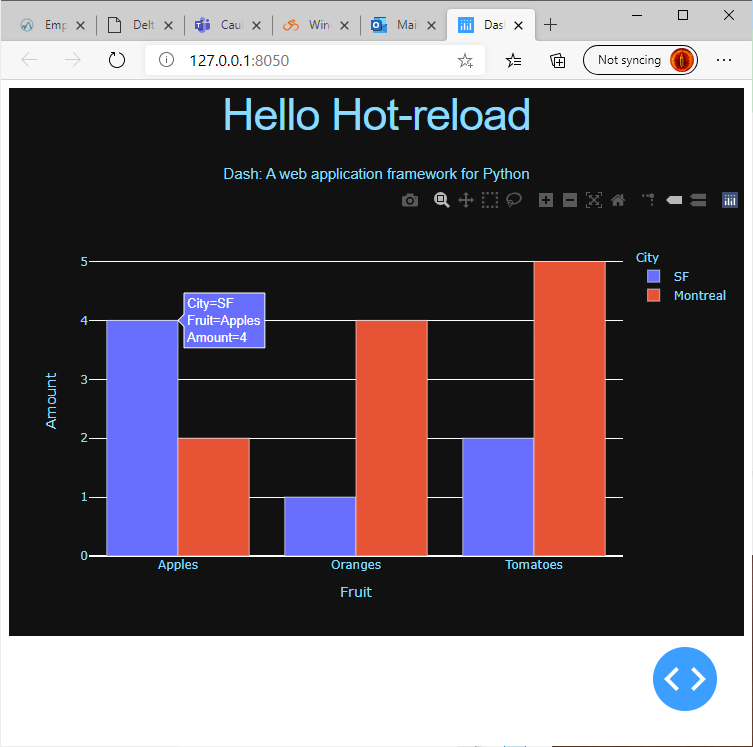
  • Hot-reloading is cool, and works with data or text changes. And the management of the html is nice. It appears to be based on a React engine and it’s nice to not have to care!
  • CSS-type styling works! If you make an error in the code, the program bails with an error message
  • 3:30 Meeting – cancelled

Phil 12.2.20

Call stove repair 

IntelliJ has added CodeWithMe!

I love this kind of simplifying, generalizing research:

https://twitter.com/samgreydanus/status/1333887306940387329

Book

  • More on cults, probably. Just need to get started writing again after the break – made a lot of progress!

GPT-2

  • Look at libraries for plotting embeddings interactively. The OpenGL developer in me is digging VisPy

GOES

  • SATERN training
  • Register for MORS!!! – Done!
  • 1:30 meeting with Vadim
    • Went over the Pyomo api, which is very complicated to install. It works, but getting the solvers to work in the API call framework requires all kinds of additional work.
  • 2:00 Meeting

Phil 12.1.20

Language Through a Prism: A Spectral Approach for Multiscale Language Representations (Twitter summary)

  • Language exhibits structure at different scales, ranging from subwords to words, sentences, paragraphs, and documents. To what extent do deep models capture information at these scales, and can we force them to better capture structure across this hierarchy? We approach this question by focusing on individual neurons, analyzing the behavior of their activations at different timescales. We show that signal processing provides a natural framework for separating structure across scales, enabling us to 1) disentangle scale-specific information in existing embeddings and 2) train models to learn more about particular scales. Concretely, we apply spectral filters to the activations of a neuron across an input, producing filtered embeddings that perform well on part of speech tagging (word-level), dialog speech acts classification (utterance-level), or topic classification (document-level), while performing poorly on the other tasks. We also present a prism layer for training models, which uses spectral filters to constrain different neurons to model structure at different scales. Our proposed BERT + Prism model can better predict masked tokens using long-range context and produces multiscale representations that perform better at utterance- and document-level tasks. Our methods are general and readily applicable to other domains besides language, such as images, audio, and video.

A Visual Guide to Regular Expression

https://twitter.com/emollick/status/1333571781727318019

This could be something for diversity injection?

Corporate Reporting in the Era of Artificial Intelligence

  • The researchers find that companies expecting higher levels of machine readership prepare their disclosures in ways that are more readable by this audience. “Machine readability” is measured in terms of how easily the information can be processed and parsed, with a one standard deviation increase in expected machine downloads corresponding to a 0.24 standard deviation increase in machine readability. For example, a table in a disclosure document might receive a low readability score because its formatting makes it difficult for a machine to recognize it as a table. A table in a disclosure document would receive a high readability score if it made effective use of tagging so that a machine could easily identify and analyze the content.

GPT-2 Agents

  • I want to create a database for generated output. There are two tables:
    • table_experiment – done!
      • Contains the experiment details:
        • id (key)
        • Date
        • Probe list
        • all hyperparameters
    • table_output – done!
      • id
      • experiment_id
      • root_id
      • tag (e.g. “raw”, “date”, “location”, “tweet”
      • depth (this is the index of each piece of content. Raw is 0, then each parsed out section increases depth by 1)
      • content
      • regexes
  • Created a gpt_experiments database. I need to make sure that I can read from one db and write to another
  • Good results on the test. Need to try something at a larger scale to test the embeddings:
https://viztales.com/wp-content/uploads/2020/12/image-1.png
  • 3:30 Meeting. Get script for Antonio
    • Getting small models for the long and short training sets
    • Look into embedding visualizer
    • Send Antonio info on the COVID Twitter stream while Sim assembles the scripts

GOES

  • Register for MORS
  • Status report for November