Monthly Archives: June 2018

Phil 6.8.18

7:00 – 3:30 ASRC MKT

  • We should attend this:  IEEE International Symposium on Technology and Society
    • Nov. 13 & 14th, Washington DC
    • ISTAS is a multi-disciplinary and interdisciplinary forum for engineers, policy makers, entrepreneurs, philosophers, researchers, social scientists, technologists, and polymaths to collaborate, exchange experiences, and discuss the social implications of technology.
  • More Bit by Bit
    • This looks really good. It’s on how social networks and behavior co-evolve: Social selection and peer influence in an online social network
      • Disentangling the effects of selection and influence is one of social science’s greatest unsolved puzzles: Do people befriend others who are similar to them, or do they become more similar to their friends over time? Recent advances in stochastic actor-based modeling, combined with self-reported data on a popular online social network site, allow us to address this question with a greater degree of precision than has heretofore been possible. Using data on the Facebook activity of a cohort of college students over 4 years, we find that students who share certain tastes in music and in movies, but not in books, are significantly likely to befriend one another. Meanwhile, we find little evidence for the diffusion of tastes among Facebook friends—except for tastes in classical/jazz music. These findings shed light on the mechanisms responsible for observed network homogeneity; provide a statistically rigorous assessment of the coevolution of cultural tastes and social relationships; and suggest important qualifications to our understanding of both homophily and contagion as generic social processes.
  • Cleaning up the SASO paper. Lots of good suggestions.
  • Got Aaron up to 16.5 on the 16 mile loop today!

Phil 6.7.18

7:00 – 4:30 ASRC MKT

  • Che Dorval
  • Done with the whitepaper! Submitted! Yay! Add to ADP
  • The SLT meeting went well, apparently. Need to determine next steps
  • Back to Bit by Bit. Reading about mass collaboration. eBird looks very interesting. All kinds of social systems involved here.
    • Research
      • Deep Multi-Species Embedding
        • Understanding how species are distributed across landscapes over time is a fundamental question in biodiversity research. Unfortunately, most species distribution models only target a single species at a time, despite strong ecological evidence that species are not independently distributed. We propose Deep Multi-Species Embedding (DMSE), which jointly embeds vectors corresponding to multiple species as well as vectors representing environmental covariates into a common high-dimensional feature space via a deep neural network. Applied to bird observational data from the citizen science project \textit{eBird}, we demonstrate how the DMSE model discovers inter-species relationships to outperform single-species distribution models (random forests and SVMs) as well as competing multi-label models. Additionally, we demonstrate the benefit of using a deep neural network to extract features within the embedding and show how they improve the predictive performance of species distribution modelling. An important domain contribution of the DMSE model is the ability to discover and describe species interactions while simultaneously learning the shared habitat preferences among species. As an additional contribution, we provide a graphical embedding of hundreds of bird species in the Northeast US.
  • Start fixing This one Simple Trick
    • Highlighted all the specified changes. There are a lot of them!
    • Started working on figure 2, and realized (after about an hour of Illustrator work) that the figure is correct. I need to verify each comment before fixing it!
  • Researched NN anomaly detection. That work seems to have had its heyday in the ’90s, with more conventional (but computationally intensive) methods being preferred these days.
  • I also thought that Dr. Li’s model had a time-orthogonal component for prediction, but I don’t think that’s true. THe NN is finding the frequency and bounds on its own.
  • Wrote up a paragraph expressing my concerns and sent to Aaron.

Phil 6.6.18

7:00 – 4:30 ASRC MKT

  • Finished the white paper
  • Peer review of Dr. Li’s AIMS work
  • Computational Propaganda in the United States of America: Manufacturing Consensus Online
    • Do bots have the capacity to influence the flow of political information over social media? This working paper answers this question through two methodological avenues: A) a qualitative analysis of how political bots were used to support United States presidential candidates and campaigns during the 2016 election, and B) a network analysis of bot influence on Twitter during the same event. Political bots are automated software programs that operate on social media, written to mimic real people in order to manipulate public opinion. The qualitative findings are based upon nine months of fieldwork on the campaign trail, including interviews with bot makers, digital campaign strategists, security consultants, campaign staff, and party officials. During the 2016 campaign, a bipartisan range of domestic and international political actors made use of political bots. The Republican Party, including both self-proclaimed members of the “alt-right” and mainstream members, made particular use of these digital political tools throughout the election. Meanwhile, public conversation from campaigners and government representatives is inconsistent about the political influence of bots. This working paper provides ethnographic evidence that bots affect information flows in two key ways: 1) by “manufacturing consensus,” or giving the illusion of significant online popularity in order to build real political support, and 2) by democratizing propaganda through enabling nearly anyone to amplify online interactions for partisan ends. We supplement these findings with a quantitative network analysis of the influence bots achieved within retweet networks of over 17 million tweets, collected during the 2016 US election. The results of this analysis confirm that bots reached positions of measurable influence during the 2016 US election. Ultimately, therefore, we find that bots did affect the flow of information during this particular event. This mixed methods approach shows that bots are not only emerging as a widely-accepted tool of computational propaganda used by campaigners and citizens, but also that bots can influence political processes of global significance.

Phil 6.5.18

7:00 – 6:00 ASRC

  • Read the SASO comments. Most are pretty good. My reviewer #2 was #3 this time. There is some rework that’s needed. Most of the comments are good, even the angry ones from #3, which are mostly “where is particle swarm optimization???”
  • Got an example quad chart from Helena that I’m going to base mine on
  • Neat thing from Brian F: grayson-map-2
  • Lots. Of. White. Paper.

Phil 6.4.18

7:00 – 4:00 ASRC MKT

  • Got accepted to SASO!
  • Listening to a show about energy in bitcoin mining. There are ramifications to AI, since that’s also expensive processing.
  • Thinking about the ramifications of ‘defect always’ emerging in a society.
  • More Bit by Bit
  • Quad chart
  • Fika

Phil 6.2.18

Wow:

  • New internet accounts are Russian ops designed to sway U.S. voters, experts say
    • A website called usareally.com appeared on the internet May 17 and called on Americans to rally in front of the White House June 14 to celebrate President Donald Trump’s birthday, which is also Flag Day.FireEye, a Milpitas, Calif., cybersecurity company, said Thursday that USA Really is a Russian-operated website that carries content designed to foment racial division, harden feelings over immigration, gun control and police brutality, and undermine social cohesion.The website’s operators once worked out of the same office building in St. Petersburg, Russia, where the Kremlin-linked Internet Research Agency had its headquarters, said Lee Foster, manager of information operations analysis for FireEye iSIGHT Intelligence.

CEPE 2019: 28–30 May, 2019, Norfolk, Virginia, USA

  • CEPE (Computer Ethics—Philosophical Enquiry) is a leading international conference and has played a significant role in defining the field since its first event in 1997. CEPE is held biennially, and is organized by INSEIT (the International Society for Ethics and Information Technology). For CEPE 2019, the conference theme will be Risk and Cybersecurity. We encourage submissions on this theme, but welcome submissions on any topic related to ethics and computers.

Phil 6.1.18

7:00 – 6:00 ASRC MKT

  • Bot stampede reaction to “evolution” in a thread about UNIX. This is in this case posting scentiment against the wrong thing. There are layers here though. It can also be advertising. Sort of the dark side of diversity injection.
  • Seems like an explore/exploit morning
  • Autism on “The Leap”: Neurotypical and Neurodivergent (Neurodiversity)
  • From a BBC Business Daily show on Elon Musk
    • Thomas Astebro (Decision Science): The return to independent invention: evidence of unrealistic optimism, risk seeking or skewness loving? 
      • Examining a sample of 1,091 inventions I investigate the magnitude and distribution of the pre‐tax internal rate of return (IRR) to inventive activity. The average IRR on a portfolio investment in these inventions is 11.4%. This is higher than the risk‐free rate but lower than the long‐run return on high‐risk securities and the long‐run return on early‐stage venture capital funds. The portfolio IRR is significantly higher, for some ex anteidentifiable classes of inventions. The distribution of return is skew: only between 7‐9% reach the market. Of the 75 inventions that did, six realised returns above 1400%, 60% obtained negative returns and the median was negative.
  • Myth of first mover advantage
    • Conventional wisdom would have us believe that it is always beneficial to be first – first in, first to market, first in class. The popular business literature is full of support for being first and legions of would-be business leaders, steeped in the Jack Welch school of business strategy, will argue this to be the case. The advantages accorded to those who are first to market defines the concept of First Mover Advantage (FMA). We outline why this is not the case, and in fact, that there are conditions of applicability in order for FMA to hold (and these conditions often do not hold). We also show that while there can be advantages to being first, from an economic perspective, the costs generally exceed the benefits, and the full economics of FMA are usually a losing proposition. Finally, we show that increasingly, we live in a world where FMA is eclipsed by innovation and format change, rendering the FMA concept obsolete (i.e. strategic obsolescence).
  • More Bit by Bit
  • Investigating the Effects of Google’s Search Engine Result Page in Evaluating the Credibility of Online News Sources
    • Recent research has suggested that young users are not particularly skilled in assessing the credibility of online content. A follow up study comparing students to fact checkers noticed that students spend too much time on the page itself, while fact checkers performed “lateral reading”, searching other sources. We have taken this line of research one step further and designed a study in which participants were instructed to do lateral reading for credibility assessment by inspecting Google’s search engine result page (SERP) of unfamiliar news sources. In this paper, we summarize findings from interviews with 30 participants. A component of the SERP noticed regularly by the participants is the so-called Knowledge Panel, which provides contextual information about the news source being searched. While this is expected, there are other parts of the SERP that participants use to assess the credibility of the source, for example, the freshness of top stories, the panel of recent tweets, or a verified Twitter account. Given the importance attached to the presence of the Knowledge Panel, we discuss how variability in its content affected participants’ opinions. Additionally, we perform data collection of the SERP page for a large number of online news sources and compare them. Our results indicate that there are widespread inconsistencies in the coverage and quality of information included in Knowledge Panels.
  • White paper
    • Add something about geospatial mapping of belief.
    • Note that belief maps are cultural artifacts, so comparing someone from one belief space to others in a shared physical belief environment can be roughly equivalent to taking the dot product of the belief space vectors that you need to compare. This could produce a global “alignment map” that can suggest how aligned, opposed, or indifferent a population might be with respect to an intervention, ranging from medical (Ebola teams) to military (special forces operations).
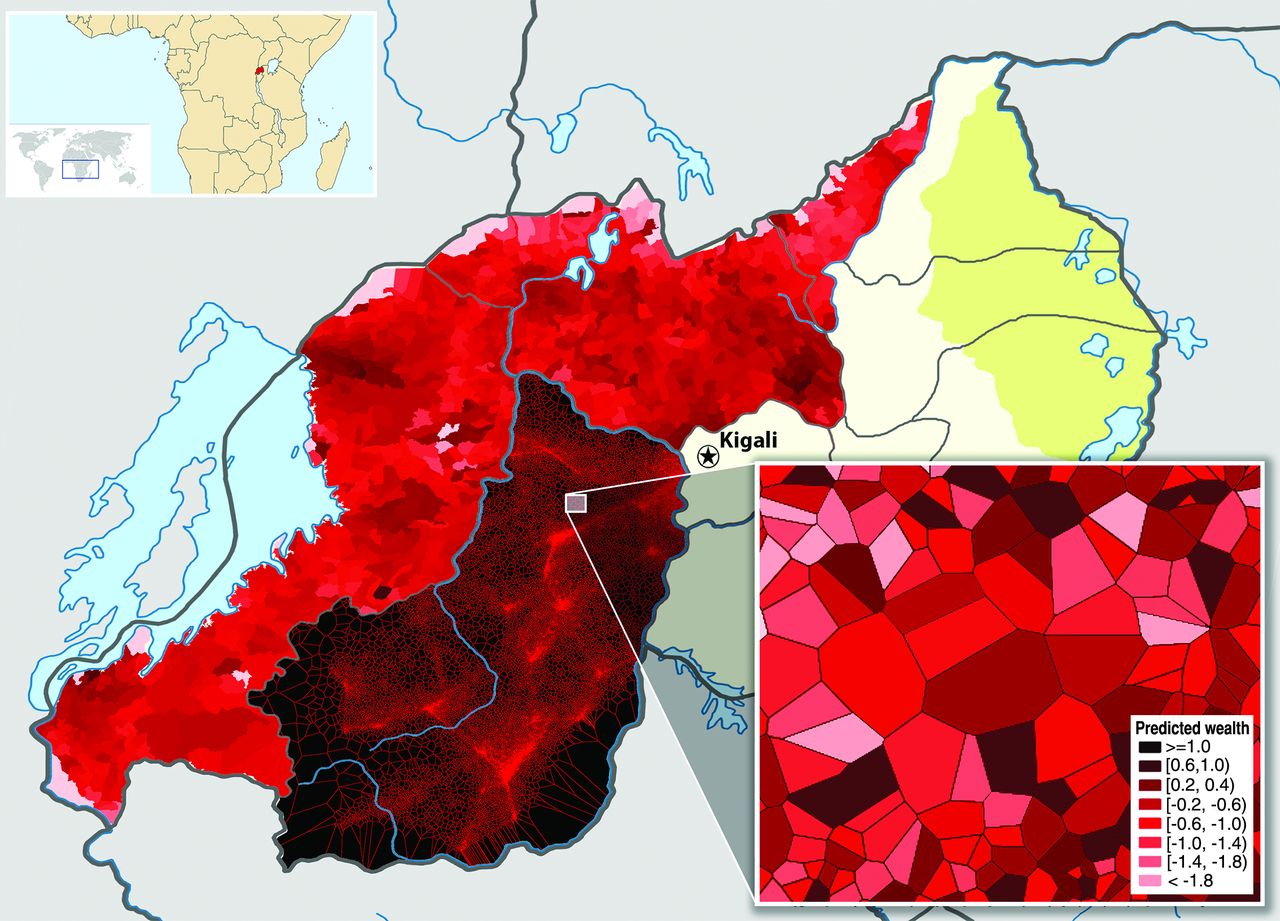
      • Similar maps related to wealth in Rwanda based on phone metadata: Blumenstock, Joshua E., Gabriel Cadamuro, and Robert On. 2015. “Predicting Poverty and Wealth from Mobile Phone Metadata.” Science350 (6264):1073–6. https://doi.org/10.1126/science.aac4420F2.large
    • Added a section about how mapping belief maps would afford prediction about local belief, since overall state, orientation and velocity could be found for some individuals who are geolocated to that area and then extrapolated over the region.